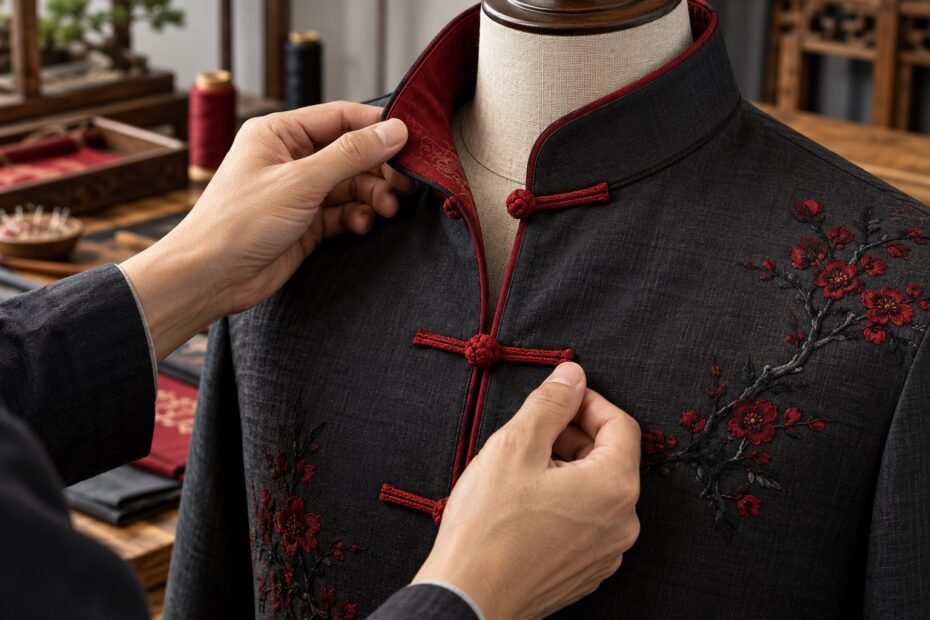
A good Tang suit jacket should match its description, fit its intended wearer, fasten securely and remain comfortable during normal use. Quality cannot be judged from price, shine or embroidery alone. The most reliable comparison combines verified product information with close inspection of measurements, construction and finish.
Use the following criteria in the same order when comparing jackets from different sellers.
Start with complete and specific product information
A trustworthy product page should make it possible to identify exactly what is being offered. Look for a clear product name, available colors and sizes, useful photographs, garment measurements, material information and care instructions.
Missing information does not automatically mean the garment is poor, but it increases uncertainty. Ask the seller to confirm any detail that could affect fit, comfort, care or import requirements. Do not infer fabric composition from appearance.
Panda-Tang currently lists two men’s styles: a dragon embroidery long-sleeved Tang suit and a bamboo leaf casual long-sleeved Tang suit shirt. The first lists dark blue, grey and red color options, while the second lists brown and red. Both show XS through L as selectable sizes. Buyers should still confirm current availability and exact measurements.
Compare measurements, not just size labels
The same size label can represent different garment dimensions across sellers or styles. Compare at least:
- shoulder width;
- chest circumference;
- garment length;
- sleeve length;
- upper-arm width, when available;
- hem width, when relevant.
Measure a similar garment that already fits and compare garment to garment. Body measurements and garment measurements are not interchangeable because clothing requires ease. Ask the seller how the measurements were taken and whether small production variations are possible.
Inspect frog buttons as working components
Frog buttons attract attention, but they also need to function repeatedly. Check whether the knots and loops are consistent in size, positioned symmetrically and attached securely.
When the jacket is fastened:
- the front edges should align;
- the loops should not appear stretched;
- the knots should not rotate excessively;
- the attachment stitching should not pull away from the fabric;
- opening and closing should not require force that could damage the trim.
For a sample or in-person inspection, operate every fastening several times. For an online purchase, request close-up photographs if the product page does not show the attachment points clearly.
Examine seam consistency and reinforcement
Straight seams should remain straight, and paired areas should look balanced. Pay particular attention to the underarms, shoulder seams, side seams, sleeve attachments and the points where decorative fastenings meet the body.
Loose thread ends can often be trimmed, but skipped stitches, open seams or irregular tension may signal a more significant construction issue. Interior seam finishing also matters because rough edges can affect comfort and durability.
Judge embroidery by execution and placement
Embroidery quality includes stitch consistency, edge definition, thread security and alignment with the garment. A complex motif is not automatically better than a simple one.
Check whether:
- the motif sits where the product description and photos indicate;
- left and right elements are intentionally balanced;
- the surrounding fabric puckers;
- thread ends are secured;
- dense areas feel excessively stiff for the intended movement;
- the design remains visually level when the jacket is worn.
Evaluate the motif separately from the garment construction. Strong embroidery cannot correct poor fit or weak seams.
Confirm fabric facts instead of relying on visual cues
Words such as silk, brocade, satin and cotton describe different aspects of fiber or construction and should not be used interchangeably without evidence. Ask for the stated fiber composition and care label. If the answer is unclear, treat the material as unconfirmed.
For practical comparison, consider:
- surface feel and drape;
- weight and seasonal comfort;
- lining or lack of lining;
- tendency to crease;
- care method;
- color consistency under normal light;
- suitability for repeated wear.
Wholesale buyers may also need labeling, packaging and testing information for their destination market. Those requirements should be confirmed before a bulk order rather than assumed from a retail listing.
Test fit through movement
Quality includes how well the garment works on the intended body. Fasten the jacket, breathe normally, reach forward, bend the elbows, turn the torso and sit down. Watch the collar, shoulder, chest and closure line.
Large horizontal creases across the chest, sharp pulling at the upper back, twisting closures or a collar that moves dramatically can indicate a fit mismatch. Excess fabric can also reduce comfort if it interferes with the hands or bunches while seated.
Compare photographs critically
Product photos should help answer specific questions. Look for front, back, side and close-up views. A useful image set should show the collar, all closures, sleeve shape, hem, embroidery and fabric surface.
Color can vary across screens and lighting conditions. If an exact shade matters for a wedding, group uniform or retail collection, request confirmation or a sample. Treat heavily edited lifestyle images as styling inspiration, not measurement evidence.
Review the seller’s policies and communication
Product quality and purchase risk are related but separate. Before ordering, review shipping, return and exchange information. Confirm who pays return shipping, whether worn or altered garments can be returned, and what evidence is required for a quality claim.
The seller should answer product-specific questions without inventing details. A clear response that marks an item as unavailable or unconfirmed is more useful than an unsupported promise.
Tang suit jacket comparison table
| Criterion | What to verify | Warning sign |
|---|---|---|
| Measurements | Actual garment dimensions and measurement method | Size label only |
| Frog buttons | Symmetry, attachment and ease of use | Twisting, loose stitching or strained loops |
| Seams | Consistent stitching and reinforced stress points | Open seams, skipped stitches or puckering |
| Embroidery | Secure thread, clean edges and balanced placement | Loose ends, distortion or unexplained mismatch |
| Material | Confirmed fiber composition and care method | Assumptions based only on shine or texture |
| Fit | Comfortable breathing, reaching and sitting | Persistent pulling or closure distortion |
| Photos | Multiple angles and close-up construction views | Only distant or heavily edited images |
| Policies | Clear shipping, return and exchange terms | Important terms missing or ambiguous |
A final buying checklist
Before placing an order, save the product page and confirm:
- the exact style and color;
- garment measurements for the selected size;
- stated material composition and care instructions;
- close-up views of fastenings, seams and embroidery;
- current stock or production availability;
- shipping destination and expected timing;
- return or exchange conditions;
- additional wholesale terms when ordering in quantity.
Compare the evidence you can verify, not the number of marketing adjectives. You can review the current Panda-Tang shop or send a product-specific question before ordering.
 English
 Français