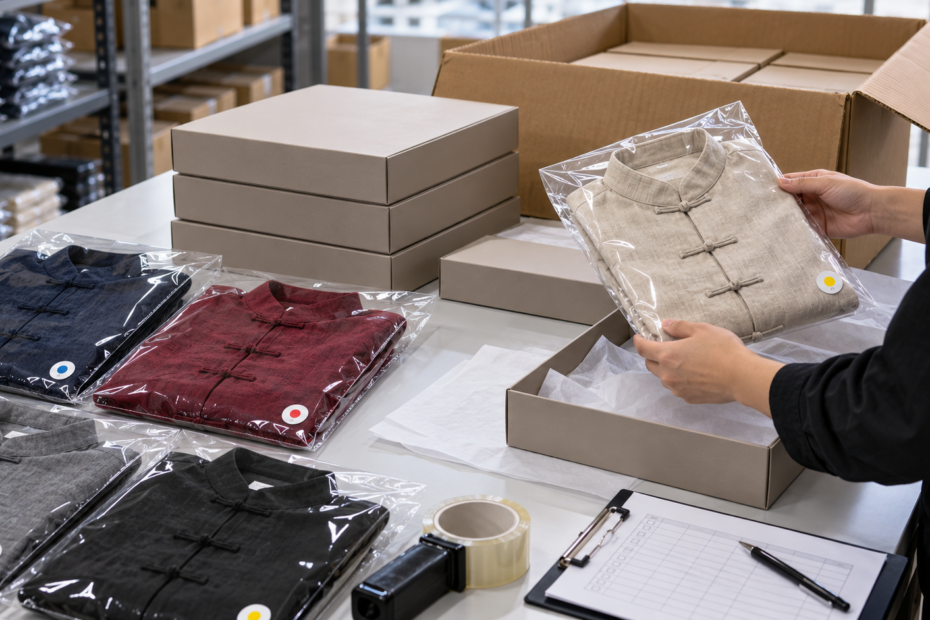
Tang suit packaging should protect the collar, frog closures, fabric surface, embroidery, and retail presentation from the packing table to the final customer. Buyers should issue a written pack specification with approved materials, folding method, labels, carton assortment, and destination requirements.
Map the distribution journey
State whether goods move to a warehouse, retail store, event team, marketplace fulfillment center, or individual customer. Include transport mode, storage time, humidity exposure, handling, and whether units will be reshipped. Packaging should solve the real journey without unnecessary bulk.
Approve the folding method
Show how sleeves, body, trousers, and accessories are folded. Avoid pressure directly on standing collars, decorative frogs, raised embroidery, or stiff trim. Use tissue or forms only where they provide clear protection. Photograph the approved pack from each stage.
Specify the inner package
Define bag or box material, dimensions, closure, ventilation, tissue, moisture control if justified, warning text, and recyclability claims that can be supported. Confirm destination legal requirements with qualified local advice rather than copying another market’s label.
Control unit labels
List product code, style, color, size, barcode, country-of-origin information, care label references, and any customer-specific marks. Provide placement diagrams and machine-readable files where needed. Test barcode readability through the final packaging.
Protect retail presentation
Decide whether garments must be shelf-ready, hanger-ready, gift-ready, or repacked by the buyer. Premium boxes add cost and volume; simple bags may expose the collar to crushing. Select presentation based on channel economics and damage risk.
Build carton assortments
Specify units per carton, size and color ratio, maximum dimensions and weight, dividers, carton strength, sealing, marks, and pallet rules. Mixed cartons need a clear assortment label. The packing list and actual contents must match.
Test before bulk packing
Run a pack trial with production-intent materials. Check compression, movement, moisture risk, abrasion, wrinkles, collar shape, decoration, and unpacking time. Where appropriate, agree transport tests with the logistics provider or inspection company.
Inspect packaging during shipment checks
- Correct unit and carton materials.
- Approved fold and garment orientation.
- Labels and barcodes match the product.
- Carton quantity and assortment are accurate.
- No crushing, moisture, contamination, or sharp edges.
- Documents match the shipment.
Balance protection and waste
Remove packaging that does not reduce damage, handling, or customer confusion. Do not make unsupported environmental claims. Record material changes because a cheaper substitute can alter protection, appearance, weight, and compliance.
Review wholesale information, send requirements through the contact page, view the shop, and visit Panda-Tang for company information.
 English
 Français