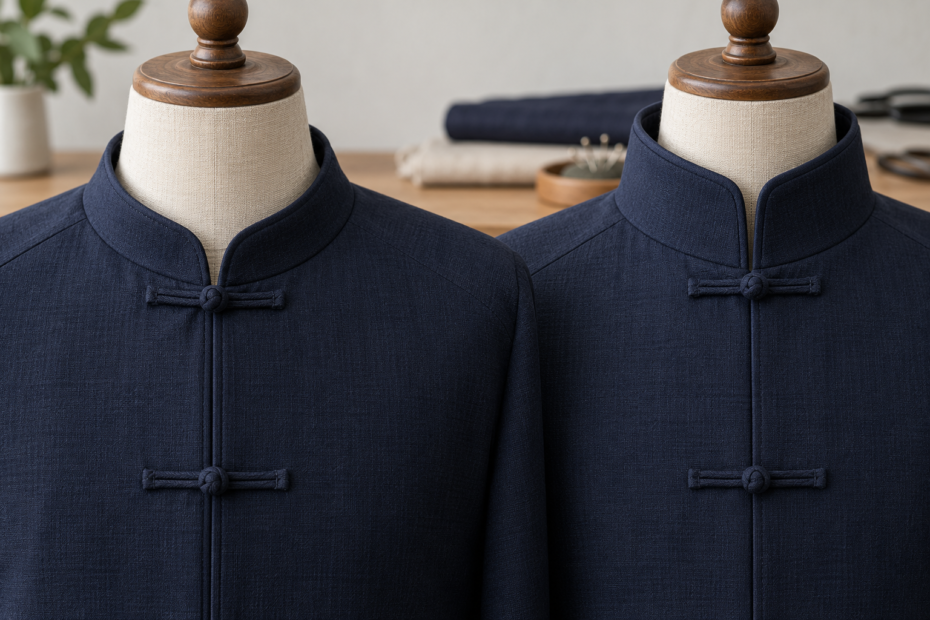
“Mandarin collar” and “Mao collar” are not consistently defined retail categories, so the better Tang suit collar is the one whose actual height, shape, stiffness, opening, and neck circumference suit the wearer. Sellers may use the two labels interchangeably or apply them to different standing collars. Compare construction and measurements rather than buying by name.
Start with the shared feature: an upright collar
Both labels commonly refer to a short band that stands around the neck instead of folding into lapels. On a Tang suit, that collar usually meets at the front opening and may close with a frog, button, hook, or concealed fastening.
The visual category is broad. Collar edges may be rounded or square, the front may meet or leave a gap, and the band may be soft or strongly interfaced.
Why the terminology is unreliable
Retailers, costume sellers, tailors, and fashion writers do not always use Mandarin collar and Mao collar in the same way. One seller may call any upright band a Mandarin collar, while another reserves Mao collar for a taller or more military-looking version. Product titles rarely provide enough information to settle the difference.
Ask for close photographs and finished measurements. A precise description such as “3 cm soft standing collar with rounded front edges” is more useful than either label by itself.
Compare collar height
A lower collar can feel less restrictive and may suit a shorter neck or relaxed shirt-style garment. A taller collar creates a stronger frame around the face and can make a jacket appear more formal, but it may press under the jaw or rub during long wear.
Measure collar height at the center back and front. Turn the head, look down, and sit while fastened. Comfort cannot be judged from a front photograph.
Check the front shape and opening
Rounded front corners create a softer transition into the frog closure. Squarer edges can look sharper and more structured. Some collars meet fully at center front; others leave a narrow opening by design.
The opening should remain balanced when the jacket is fastened. A gap caused by chest strain or incorrect neck circumference is not the same as an intentional design.
Evaluate stiffness and support
Interfacing helps a standing collar keep its shape. Light support can feel natural in a casual garment, while stronger structure produces a crisp formal outline. Too much stiffness may cause rubbing; too little can make the collar collapse or roll.
Ask whether the collar is fused, sewn, padded, or otherwise supported only when the supplier can verify it. Follow care instructions because heat and moisture can affect some structures.
Measure neck circumference and overlap
The collar should close without pressure on the throat and without a large gap. Compare the finished inner circumference with the wearer’s neck and intended base layer. Allow enough room for breathing and movement rather than using one universal ease value.
Test the top fastening while seated. If the wearer plans to leave it open, confirm that the collar still lies neatly and does not expose an awkward base-layer edge.
Consider the closure
A small frog at the neck reinforces the Tang suit look but may require dexterity. Buttons, hooks, or hidden snaps can change convenience and load distribution. Verify which fastening is functional and which is decorative.
The closure should not twist the collar or pull one front edge higher. Repeatedly open and close it before an event.
Match the collar to the jacket silhouette
A low, soft collar often works with a relaxed shirt-jacket and patch pockets. A taller, cleaner collar can support a fitted jacket with tailored trousers. These are design relationships, not historical rules.
View the complete outfit. A collar that looks elegant in a close-up may appear too tall or too small relative to the wearer’s head, shoulders, and jacket length.
Choose for the occasion
- Formal wedding or banquet: a structured collar can create a sharper outline if it remains comfortable.
- Smart casual: a lower or softer collar usually feels easier and less ceremonial.
- Performance: collar security and freedom of neck movement matter more than the label.
- Long seated event: prioritize circumference, edge softness, and pressure testing.
Do not use the name as a cultural guarantee
Neither label proves that a garment reproduces one exact historical pattern, region, or political-era uniform. Modern Tang suits combine contemporary retail terminology with varied design influences. Specific historical claims require evidence beyond collar shape.
A better buying checklist
- Request front, side, back, and interior collar photos.
- Confirm collar height and inner circumference.
- Check edge shape, opening, and fastening.
- Ask about stiffness, lining, and care.
- Wear the intended base layer.
- Turn, look down, sit, and speak while fastened.
- Judge the collar with the whole outfit.
Compare collar treatment on a dragon-embroidery Tang suit and a bamboo-leaf casual Tang shirt. Browse the Panda-Tang shop, then visit Panda-Tang to verify current measurements, materials, care, availability, returns, and delivery.
 English
 Français