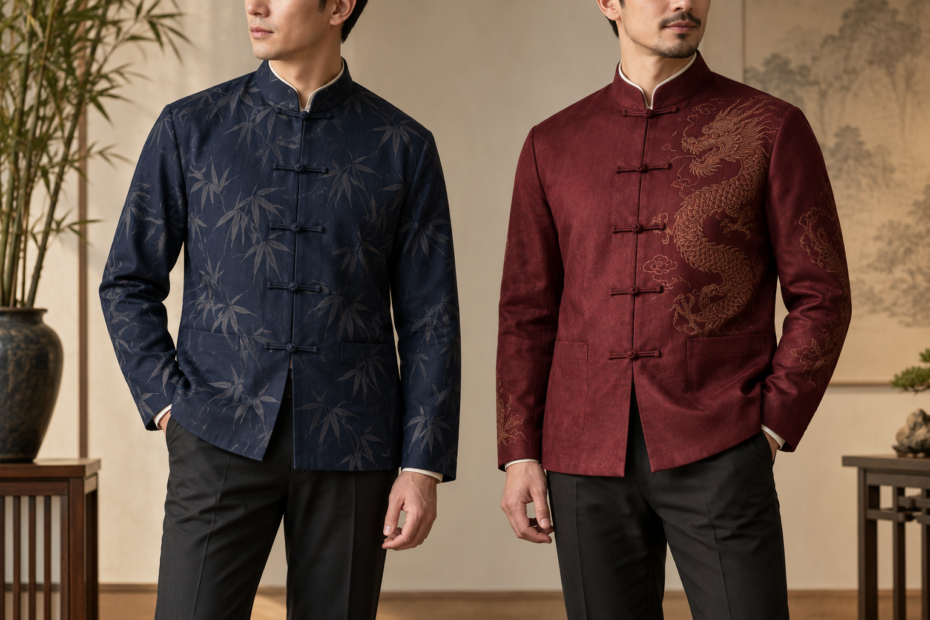
A bamboo-pattern Tang suit usually creates a quieter, nature-inspired surface, while a dragon-embroidered Tang suit makes a stronger event statement. Neither motif has one universal meaning or dress level, so the garment’s construction, the wearer’s role, and the host’s expectations should guide the choice.
Compare the motifs before interpreting them
Bamboo leaves may be woven, printed, embroidered, or simply used as a decorative pattern. A dragon may likewise be stitched, appliqued, printed, or woven into jacquard.
Ask the seller to identify the technique and provide close photographs. Do not infer historical rank, handwork, fiber content, or a universal symbolic meaning from the motif alone.
How bamboo changes the visual effect
A small tonal bamboo pattern can read as texture from a distance and reveal detail up close. It often supports casual dinners, community events, travel, and celebrations where the wearer wants a distinctive but controlled look.
Large or high-contrast bamboo designs can still be bold. Scale, placement, color, and sheen matter more than the plant name by itself.
How dragon embroidery changes the visual effect
Dragon embroidery tends to attract attention because it is often larger, more figurative, and more contrasting. That can suit a groom, host, performer, or featured guest when the event plan supports it.
A bold dragon design can compete with a partner’s clothing or the main participants. Guests should check the expected attention level before choosing a statement jacket.
Match the occasion
Bamboo-pattern Tang suits can move between casual celebrations, cultural programs, dinners, and smart-casual settings when the fabric and cut fit the dress code.
Dragon-embroidered styles can suit weddings, banquets, festivals, galas, and performances, but the host should approve prominent imagery for ceremonies or coordinated events.
Compare formality through construction
A structured lined bamboo-pattern jacket may look more formal than an unlined dragon-print shirt. Embroidery alone does not determine formality.
Evaluate jacket structure, fabric weight, lining, closure quality, trousers, and shoes. Product titles are only a starting point.
Consider color and lighting
Navy, black, charcoal, and subdued green can keep bamboo patterns understated. Burgundy, red, navy, or black can make dragon embroidery range from tonal to high contrast.
View the garment in daylight, warm indoor light, and flash. Metallic threads and glossy fabric may appear brighter in photographs than on screen.
Check motif placement against fit
Patterns should remain balanced when the jacket is fastened. Sizing up can move bamboo leaves, embroidery, pockets, and closures away from their intended position.
Measure shoulder, chest, midsection, sleeve, and back length. Fit takes priority over how the motif looks on a model.
Plan trousers and shoes
Plain black or charcoal tailored trousers keep either patterned jacket visually grounded. A bamboo style may also work with cream or relaxed trousers when the event permits.
Polished dark shoes increase formality; simple loafers create a lighter modern outfit. Avoid adding multiple competing motifs through accessories.
Compare care and alteration
Raised dragon embroidery may snag and can restrict changes near seams, cuffs, or hems. Woven or printed bamboo patterns can also be delicate depending on the base fabric.
Follow the sewn-in care label and ask a tailor before altering decorated panels. Never assume two motif styles share the same cleaning method.
Consider rewear
Tonal bamboo is often easy to combine with different trousers and may fit more everyday occasions. A large contrasting dragon can become a memorable signature piece with fewer suitable settings.
Rewear is only one factor. The right choice should feel appropriate to the event and comfortable for the wearer.
Final decision checklist
- Confirm the event dress code and the wearer’s role.
- Verify whether the motif is woven, printed, embroidered, or applied.
- Avoid unsupported claims about symbolism or historical status.
- Compare finished measurements before ordering.
- Inspect the full outfit under expected lighting.
- Review care, alteration, delivery, and return terms.
Choose a bamboo-pattern Tang suit for quieter texture and broader styling flexibility. Choose dragon embroidery when the event deliberately welcomes a visible motif and the wearer is comfortable making it the focal point.
Compare a detailed dragon-embroidery Tang suit with a softer bamboo-leaf casual Tang shirt. Browse the Panda-Tang shop, then visit Panda-Tang to verify current measurements, materials, care, stock, returns, and delivery.
 English
 Français