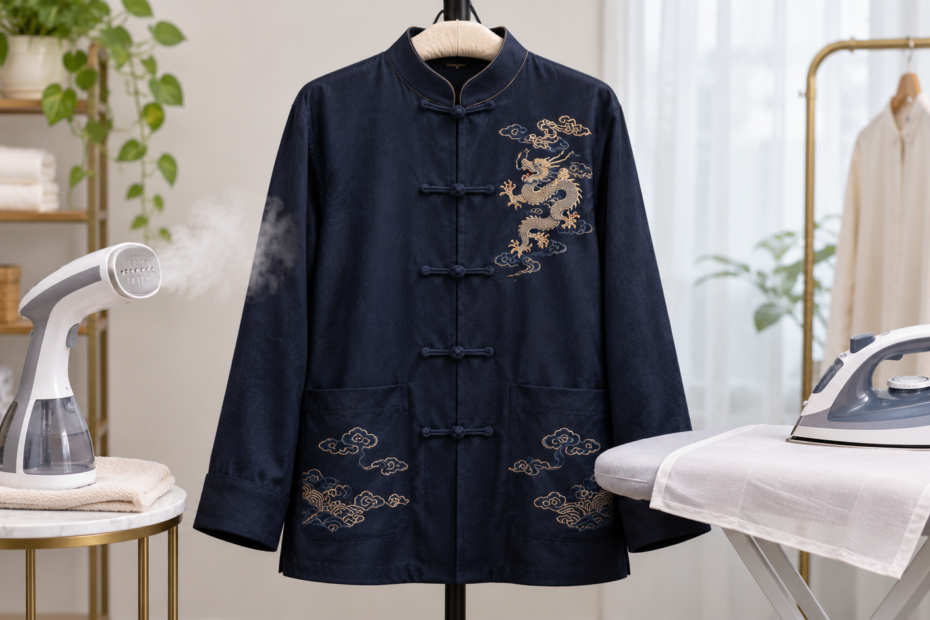
The care label decides whether a Tang suit can be steamed, ironed, or professionally pressed. Steaming can relax light wrinkles with less direct pressure, while ironing can create a sharper finish; either method can damage fabric, lining, dye, frog closures, or embroidery when heat and moisture are not approved.
Start with the care label
Tang suits range from washable casual shirts to lined brocade jackets. Their fibers, finishes, interlinings, dyes, embroidery, and closures respond differently to temperature, moisture, and pressure.
If the label is missing or unclear, ask the seller or a qualified cleaner. Do not copy a temperature from another garment that only looks similar.
When steaming may be suitable
Steaming can help release light storage wrinkles in a garment whose label permits steam. It avoids placing the weight of an iron directly on raised decoration and may be useful for sleeves or broad body panels.
Hold the garment on a supportive hanger and follow the steamer and garment instructions. Keep the head moving and never force steam into an area that shows spotting, color change, or distortion.
Limits of steaming
Steam adds heat and moisture. It can cause water marks, dye movement, shrinkage, adhesive failure, or loss of a crisp shape in susceptible fabrics and structured areas.
Do not press the steamer head against frog closures, embroidery, metallic thread, or an unknown finish. Stop immediately if the surface changes.
When ironing may be suitable
Ironing can flatten stubborn creases and restore a controlled edge when the care label allows the necessary heat. It works best on stable plain areas that can be supported evenly.
Use the specified temperature and a clean pressing cloth when recommended. Press briefly rather than sliding aggressively across the surface.
Limits of ironing
Direct contact can create shine, scorching, flattening, seam impressions, or melted synthetic fibers. High heat may also damage lining, trim, adhesives, and decorative knots.
Never iron directly over frog closures, raised embroidery, appliques, or metallic detail. A professional press is safer when the jacket is structured or valuable.
Test only when the instructions allow
If the label permits heat treatment, begin at the lowest approved setting on an inconspicuous plain area. Use a clean white cloth and inspect for color transfer, shine, texture change, and water spotting.
Do not run an improvised test on a rare or expensive garment when even a hidden mark would matter. Seek professional care instead.
Prepare the garment
Make sure the Tang suit is clean and fully dry. Heat can set some stains, while trapped moisture can produce marks or odor.
Fasten or arrange closures gently so the jacket hangs in its natural shape. Empty pockets and remove only accessories designed to be detachable.
Handle embroidery and frog closures
Work around decorated areas instead of forcing them flat. Raised threads and knots are part of the construction, not wrinkles that need removal.
Place clean padding beneath nearby plain fabric if the care instructions support pressing. Avoid snagging the steamer or iron on loops and loose threads.
Manage different wrinkle types
Light travel creases may relax after the garment hangs in a clean, dry space. Deep folds in a structured jacket may need a professional who can shape the shoulder, collar, and front correctly.
Do not repeat heat treatment endlessly. Persistent rippling may come from construction or moisture damage rather than an ordinary wrinkle.
Finish and cool correctly
Let the garment cool and dry completely on a supportive hanger before wearing or storing it. Moving warm fabric too quickly can reset creases.
Inspect front, back, sleeves, collar, closures, and lining in good light. Store only after every layer has returned to room temperature and is free of moisture.
When to use a professional
Choose professional pressing when the label requires it, the fabric is unknown, the jacket is structured, decoration is complex, or the garment has valuable or sentimental importance.
Show the cleaner the care label and identify any stains, prior treatments, loose threads, and delicate components before work begins.
Final decision checklist
- Read the garment care label.
- Identify fiber, lining, decoration, and finish.
- Use the lowest approved heat and moisture level.
- Protect embroidery and frog closures from direct contact.
- Stop if color, texture, or shape changes.
- Let the suit cool and dry fully before storage.
Choose steaming for label-approved light wrinkles when direct pressure is unnecessary. Choose ironing for label-approved plain areas that need a sharper finish, and use professional pressing whenever construction or decoration makes home treatment uncertain.
Compare a detailed dragon-embroidery Tang suit with a softer bamboo-leaf casual Tang shirt. Browse the Panda-Tang shop, then visit Panda-Tang to verify current measurements, materials, care, stock, returns, and delivery.
 English
 Français