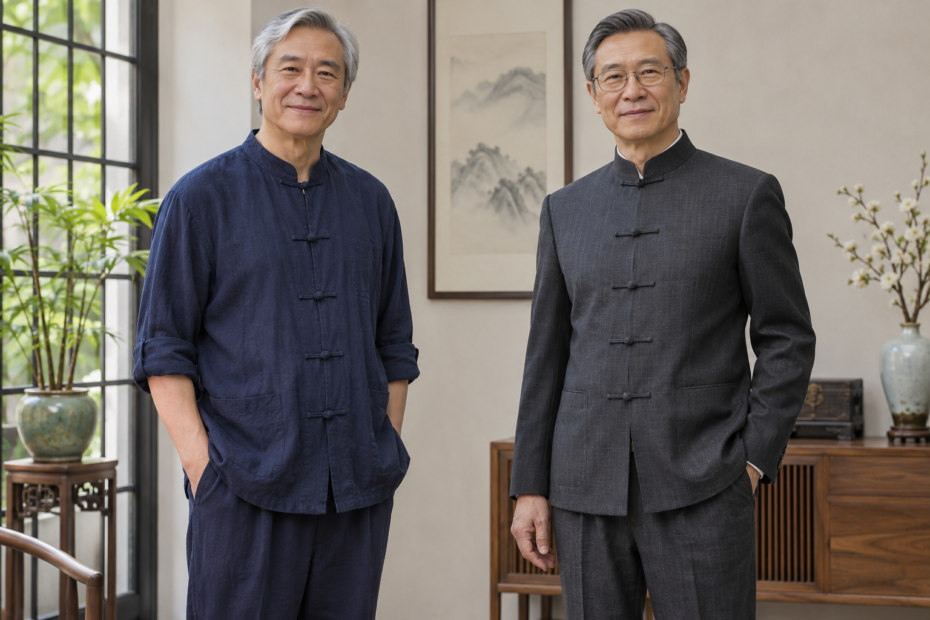
Age does not dictate whether a man should wear a relaxed or structured Tang suit. Choose according to his mobility, posture, sensory comfort, personal style, event role, climate, and willingness to tailor the garment; the best option is the one he can fasten, move in, and wear with confidence for the full schedule.
Compare shoulder and arm mobility
A relaxed jacket can provide useful ease for reaching, greeting, dining, and using mobility aids, but excess fabric should not collapse around the neck or catch on furniture. Softness is helpful only when the pattern still controls the shoulder and sleeve.
A structured jacket can create a clean formal line, yet padding, narrow armholes, or stiff fabric may restrict movement. Test the actual garment over the intended base layer rather than assuming tailoring automatically means discomfort.
Test seated comfort for the real schedule
Many celebrations involve long meals, travel, speeches, and photographs. Sit fully fastened for at least twenty minutes and check the throat, chest, abdomen, back, sleeve, and pocket areas.
A relaxed cut may accommodate posture changes more easily, while a structured front may remain neater in photographs. Either can fail if jacket length, waist ease, or trouser rise is wrong for the wearer.
Check collars and sensory pressure
The standing collar should not rub the neck, press the throat, or interfere with hearing aids, glasses cords, or medical accessories. Measure the neck and test head turns instead of relying on a generic size label.
Soft collars may feel less intrusive but can fold when too large. Structured collars look crisp but need accurate circumference, height, and stiffness. A tailor can advise whether adjustment is practical without disturbing closures or decoration.
Make closures easy to use
Frog closures vary in size, stiffness, contrast, and finger space. A wearer with reduced dexterity may prefer larger, flexible closures or discreet supported fastening, provided the product is designed that way.
Practice fastening and releasing every closure without rushing. Do not improvise with pins, tape, or magnets near medical devices; ask the maker about approved adaptations and preserve return eligibility before altering anything.
Choose fabric for climate and skin comfort
Lightweight breathable fabric can suit warm rooms and extended wear, while dense brocade, lining, and interlining may retain heat. Fiber content alone does not predict comfort because weave, finish, layers, and ventilation also matter.
Feel the collar, cuffs, seams, and lining against the planned base layer. If skin is sensitive, avoid rough metallic thread or stiff trim at contact points and confirm care instructions before washing a new garment.
Coordinate trousers and footwear
Relaxed jackets pair naturally with straight comfortable trousers, but the widths should look intentional rather than oversized. Structured jackets usually benefit from controlled trouser drape and a clean break.
Prioritize stable, supportive shoes suitable for the venue. Set trouser length while wearing those shoes, and rehearse stairs and seating so hems do not become a trip hazard.
Use tailoring selectively
Common priorities include sleeve length, trouser hem, waist ease, collar comfort, and closure alignment. Decoration near seams can make alterations expensive or impossible, so obtain an assessment before ordering custom work.
Do not force a heavily altered garment to imitate a different body shape. Good tailoring balances the wearer’s posture and proportions while preserving breathing, mobility, and the intended design.
Avoid age-based styling rules
Older men do not need dull colors, loose fits, or conservative decoration by default. Personal taste, complexion, event role, and the garment itself are more useful guides than age-based assumptions.
Present both options respectfully and let the wearer decide. A quiet relaxed navy shirt and a sharply tailored embroidered jacket can each be appropriate when fit, comfort, and context support the choice.
Turn the invitation into a clothing brief
Before comparing a relaxed Tang suit with a structured Tang suit, write down the event type, venue, season, start and finish times, indoor and outdoor segments, expected photographs, and the wearer’s role. A groom, host, speaker, parent, attendant, and ordinary guest may attend the same event but need different levels of visibility and formality.
Record any wording from the invitation instead of translating it into a preferred garment too quickly. Black tie, business formal, cultural dress, festive, historical dress, and smart casual describe different expectations. When the wording is broad, the host or organizer is a better source than a generalized online rule.
Separate garment category from product quality
Neither a relaxed Tang suit nor a structured Tang suit is automatically formal, comfortable, accurate, or well made. A category name describes a family of garments; the individual product determines fabric, pattern cutting, lining, construction, closures, finishing, and fit. Compare the actual items rather than idealized versions of each category.
Ask for clear front, side, back, interior, collar, closure, cuff, hem, and pocket photographs. Verify what is included, because styling images may show trousers, shirts, belts, shoes, jewelry, or accessories sold separately. A good comparison uses equivalent information for both choices.
Measure the wearer and a garment that fits
Body height and weight are only context. Record neck, shoulder, chest, midsection, hip, sleeve, preferred jacket or garment length, and any posture or proportion that affects fit. Use the seller’s measurement method and keep the original units to reduce conversion and rounding errors.
Measure a comfortable garment laid flat and photograph the tape position. Confirm whether a chart shows body measurements, finished-garment circumference, or flat width. If the wearer falls across sizes, identify the controlling measurement and ask whether alteration is realistic before simply choosing the largest size.
Evaluate fit through movement
A static front photograph cannot prove event-ready fit. Fasten the garment as intended, then sit, stand, walk, climb stairs, reach forward, turn, greet people, and use any ceremony posture the schedule requires. The collar should not press the throat, the shoulders should remain controlled, and closures should lie without strain.
Test the complete base layer and planned trousers or lower garment. Fabric that feels comfortable for five minutes may restrict breathing, dining, driving, or dancing over several hours. Hem, sleeve, slit, and pocket positions also need to work while moving, not only while posing.
Compare fabric with evidence
Do not identify silk, cotton, linen, wool, brocade, hand embroidery, or natural dye from a photograph. Request the stated fiber composition, lining details, fabric weight or seasonal guidance when available, stretch information, care instructions, and close views of the surface.
Sheen and texture affect formality and photography as much as color. Dense woven patterns and metallic threads can become brighter under flash; matte fabrics may look quieter but reveal lint or creasing. If swatches are available, view them in daylight and the venue’s likely artificial light.
Build a complete outfit rather than choosing one garment
List every visible component: base layer, trousers or robe layers, socks, shoes, belt, jewelry, boutonniere, bag, and outerwear. Each component should support the same level of formality. Adding several unrelated motifs or finishes can make a carefully chosen main garment look accidental.
Try the final shoes before hemming. Check what appears when the wearer sits, whether socks connect trousers and footwear, and whether an outer coat crushes the collar or decoration. Photograph front, side, and back views at conversational distance and full-body distance.
Coordinate without creating a uniform
Couples and groups do not need identical fabric or color. Coordination can come from one repeated hue, similar formality, compatible surface texture, or a shared degree of visual detail. Exact matching can look forced and may be impossible across different materials.
Place garments beside one another before deciding. A small swatch is useful, but a full outfit reveals how much visual space each color occupies. Let the people whose role is central to the event carry the strongest color, motif, or silhouette unless the group has agreed otherwise.
Use color carefully
Color meanings and wedding customs vary among families, regions, communities, and personal traditions. Do not describe one shade as universally required, forbidden, lucky, masculine, or historically correct. Ask the people organizing the event whenever color has ceremonial importance.
Screen settings and edited product photography are unreliable for exact matching. Request unfiltered daylight images or samples when the palette matters. Deep navy may photograph almost black, black can lose texture in shadow, and red or metallic surfaces can become more intense under warm light.
Plan for climate and duration
Consider travel, waiting, photography, meals, speeches, outdoor transitions, dancing, and the return journey. A dense lined garment may be comfortable in a cool room but tiring outdoors or under stage lighting. A light garment may need discreet thermal layering in cold weather.
Check ventilation, lining, sleeve width, and the ease needed over the intended base layer. Arrange a secure place for outerwear and a method for transporting the garment without crushing it. Comfort supports posture and confidence throughout a long formal event.
Understand alteration boundaries
Shoulders, collars, closure placement, embroidered panels, woven motifs, pocket positions, and long hems can be difficult or expensive to alter. A tailor needs to inspect the actual garment, seam allowance, lining, and decoration before promising a result.
Order early enough for fitting and one corrective round. Do not remove tags or commission alterations until the return policy is understood. If decoration crosses a seam or hem, ask how shortening or narrowing would change the design.
Review care before purchase
A formal garment is not practical if its required care, storage, or pressing cannot be arranged before and after the event. Read the sewn-in care label, ask how wrinkles should be removed, and identify a qualified cleaner when the item is structured, lined, or decorated.
Plan storage on a suitable hanger or in a supported fold, depending on weight and construction. Protect frog closures, embroidery, and delicate surfaces from pressure and snagging. Never assume that garments in the same category share the same cleaning method.
Check cultural and historical claims
Use accurate, limited descriptions. Contemporary Chinese-inspired formalwear, historical reconstruction, ceremonial clothing, and stage costume are not interchangeable categories. A retail title does not by itself establish dynasty, region, authenticity, symbolism, or traditional status.
When accuracy matters, consult museum collections, academic dress history, qualified practitioners, or event specialists and document which period or community is being discussed. When accuracy is not required, describe observable features without inventing lineage or meaning.
Make the final decision with a scorecard
Score a relaxed Tang suit and a structured Tang suit separately for dress-code fit, role fit, movement, climate, coordination, tailoring risk, care, delivery certainty, return terms, and realistic rewear. Weight the first six criteria more heavily than novelty or imagined versatility.
A scorecard does not replace personal preference, but it exposes tradeoffs. If both choices remain close, select the one the wearer can test properly, receive on time, and wear with confidence. If either option conflicts with the host’s instructions, remove it from consideration.
Complete a full rehearsal
At least several days before the event, wear every component together for long enough to reveal pressure, slipping, heat, and movement problems. Practice entrances, greetings, photographs, dining, stairs, and any ceremony actions. Ask a trusted observer to check the back and side views.
Prepare a small care plan with a lint brush if approved, a clean cloth for immediate blotting, spare appropriate fasteners only when supplied, and contact details for the tailor or cleaner. Do not use tape, pins, chemicals, or heat on the event day without garment-specific approval.
Verify the order before payment
Save the exact product page, selected color, size, customization notes, promised dispatch window, shipping method, taxes or duties guidance, and return conditions. Ask the seller to confirm any important point in writing, especially when the event date leaves little room for exchange. Screenshots help resolve later differences between a listing and the delivered item.
When the parcel arrives, record the unboxing, inspect the garment in clean light, and compare it with the order before removing tags. Check measurements, color, closures, seams, lining, decoration, odor, stains, and included pieces. Contact the seller promptly if something differs; do not alter, wash, press, or wear the item until the remedy and return eligibility are clear.
Final choice
Choose a relaxed Tang suit when soft structure and movement ease best serve the wearer and event. Choose a structured Tang suit when he prefers a sharper formal line and can move comfortably in the tested fit; age alone should never decide.
Compare a detailed dragon-embroidery Tang suit with a softer bamboo-leaf casual Tang shirt. Browse the Panda-Tang shop, then visit Panda-Tang to verify current measurements, materials, care, stock, returns, and delivery.
 English
 Français