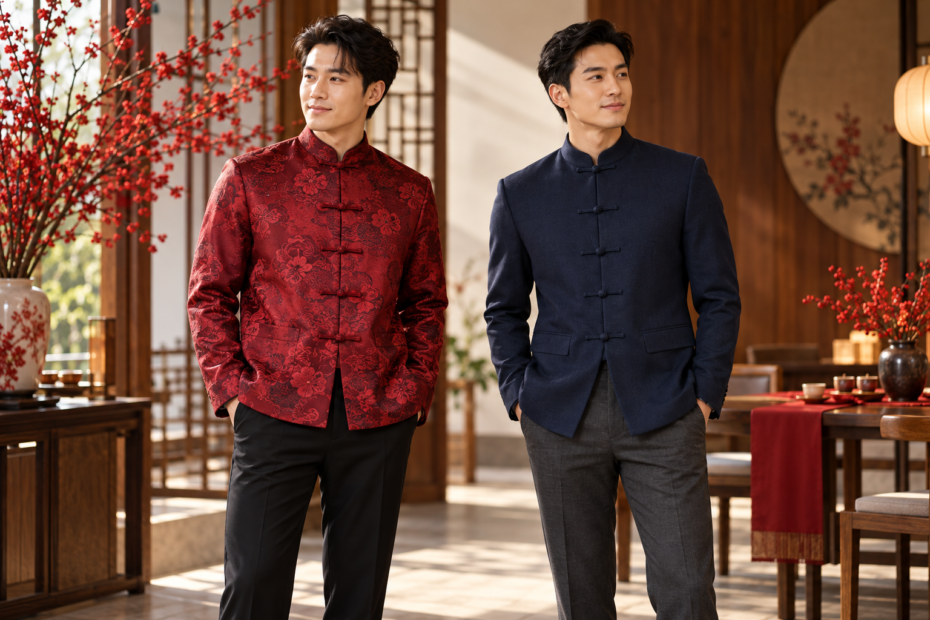
A traditional-inspired Chinese New Year Tang suit emphasizes visible heritage cues, while a modern version simplifies the shape, surface, or color for easier everyday wear. Neither category has one fixed definition, so compare the actual garment and the family’s plans rather than relying on the label alone.
What the two labels really mean
Retailers often use traditional-inspired for jackets with a standing collar, frog closures, straighter proportions, brocade, embroidery, or a festive palette. Modern Tang suits may retain the collar and closures while using quieter fabric, cleaner lines, or a more fitted cut.
These are contemporary shopping descriptions, not precise historical periods. Product construction, cultural context, and family preference are more useful evidence than a broad style name.
Start with the New Year setting
A formal family banquet, community celebration, temple visit, office gathering, and relaxed meal place different demands on clothing. Ask whether the wearer will sit for a long dinner, move outdoors, pose for group photographs, or change venues.
A highly decorated jacket can suit a planned celebration, while a restrained design may transition more comfortably between travel, work, and dinner. Hosts and family members should guide any event-specific expectation.
Compare color without assuming one rule
Red and burgundy create a visible festive effect, but no single shade is mandatory for every family or community. Navy, black, cream, and other approved colors can work when coordinated with the gathering.
Check the garment under daylight, warm indoor light, and camera flash. Brocade and metallic threads can appear brighter in photographs than they do on a product page.
Compare silhouette and fit
Traditional-inspired jackets often use a straighter body, while modern versions may narrow the waist, shoulder, or sleeve. The controlling measurements remain shoulder, chest, midsection, sleeve, and back length.
Fasten every closure and test sitting, reaching, and greeting. A fitted shape should not pull the frog closures apart, and a straight shape should not overwhelm the wearer or place motifs too low.
Compare fabric and decoration
Brocade, jacquard, embroidery, and contrast trim create visual richness but may add weight, stiffness, warmth, or special-care needs. Plain cotton blends, linen-like fabrics, or subtle woven textures can feel more relaxed.
Verify fiber content, lining, stretch, and cleaning instructions. Do not infer silk, hand embroidery, or symbolic meaning from a photograph unless the seller supplies that information.
Plan trousers, shoes, and layers
Black or charcoal tailored trousers provide a simple base for both approaches. A quieter jacket can also work with cream or tonal trousers when the event allows. Polished dress shoes raise formality; clean loafers make the outfit lighter.
Choose the base layer before sizing. A lined jacket over a shirt needs more room than the same jacket over a thin undershirt, and indoor heating can make dense fabric uncomfortable.
Consider group coordination
The wearer does not need to match relatives exactly. Repeating one color, texture, or formality level is usually enough to create a coherent family photograph.
Ask before assigning motifs or colors to people. Cultural practices vary, and respectful coordination comes from the participants rather than a universal internet rule.
Evaluate rewear value
A bold red patterned jacket may remain a dedicated celebration piece. A navy or black minimally decorated jacket can be easier to rewear at dinners and cultural events.
Rewear is useful, but it should not override the family’s plan for the main occasion. Fit, comfort, and personal confidence usually matter more than theoretical versatility.
Final decision checklist
- Confirm the event and family expectations.
- Compare finished garment measurements with a jacket that fits.
- Verify fabric, lining, care, and production tolerance.
- Test the full outfit while sitting, walking, and greeting.
- Photograph it in the expected lighting.
- Check delivery and return timing before ordering.
Choose traditional-inspired styling when the gathering calls for a stronger celebratory presence and the wearer enjoys visible pattern or structure. Choose modern styling when a quieter silhouette, easier layering, and broader rewear matter more.
Compare a detailed dragon-embroidery Tang suit with a softer bamboo-leaf casual Tang shirt. Browse the Panda-Tang shop, then visit Panda-Tang to verify current measurements, materials, care, stock, returns, and delivery.
 Français
 English