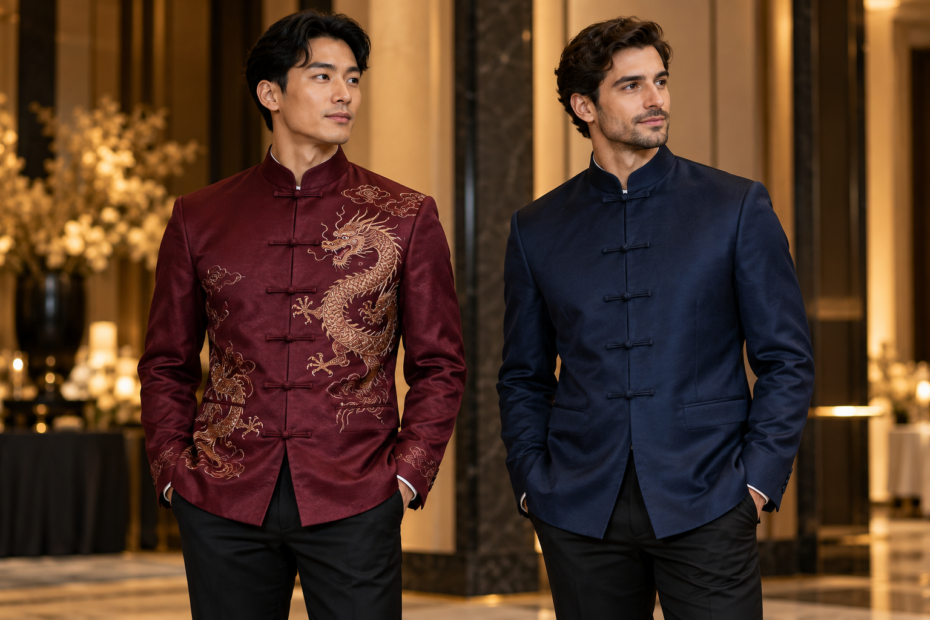
A dragon-embroidered Tang suit is a high-visibility event garment, while a plain Tang suit creates a quieter and more adaptable formal look. Choose only after confirming the host’s expectations, the motif’s suitability, the venue, photography, fit, and the wearer’s comfort with attention.
Begin with permission and context
Dragon imagery can be visually and culturally significant, but its interpretation is not identical across every family, community, period, or design. Ask the host or organizer when the motif will appear in a wedding, ceremony, or formal program.
A plain Tang suit reduces symbolic ambiguity and is easier to place when the audience, dress code, or event protocol is uncertain.
Compare attention level
A large contrasting dragon motif becomes the immediate focal point and will be prominent in photographs. It may suit a groom, host, performer, or featured participant when planned with the event.
A guest can unintentionally compete with the main participants by wearing a very bold motif. Plain or tonal styling is safer when the role should remain visually supportive.
Weddings and tea ceremonies
For a wedding, the couple and families should approve the color, motif, and degree of decoration. A dragon-embroidered jacket can be intentional for the groom or another designated role.
A plain black, navy, or burgundy Tang suit provides cultural styling without making the motif the center of the ceremony. It can also coordinate more easily with a partner’s clothing.
Banquets and cultural celebrations
A dragon motif can work well at a festive banquet, Lunar New Year gathering, gala, or cultural celebration when decorative dress is expected. Venue scale matters: a large hall can absorb a stronger design than a small dinner.
Plain Tang suits suit both festive and restrained gatherings and allow color, fabric texture, or closures to provide interest.
Performances and public appearances
Stage lighting and viewing distance may justify larger, higher-contrast decoration. Performance movement also requires secure stitching, adequate ease, and sleeves that do not interfere with the activity.
Do not treat a stage garment as proof of historically accurate dress. Follow the production’s costume direction and safety requirements.
Formal dinners and business-adjacent events
A subtle dragon motif may be appropriate at a host-approved cultural reception or gala, but bold embroidery can feel too expressive in conservative professional settings.
A plain dark Tang jacket is more restrained, yet it still may not replace a conventional Western suit where business-formal rules are explicit.
Inspect the motif and construction
Ask for close images of the embroidery, backing, edges, and placement. Confirm whether the motif is stitched, appliqued, printed, or woven, and whether the product description identifies it accurately.
Do not infer hand embroidery, precious thread, historical rank, or a universal symbolic meaning without reliable evidence.
Check fit before decoration
The shoulder seam, collar, chest, midsection, sleeve, and back length must fit before the motif is considered. A dragon distorted by pulling or moved by excessive sizing will not look intentional.
Fasten every frog closure and rehearse sitting, greeting, dining, and walking. Decoration should not hide tension or poor proportions.
Plan color and photography
Gold or bright embroidery on red, burgundy, navy, or black can change dramatically under warm light and flash. It may reflect more strongly than expected.
Photograph the full outfit beside other key clothing and decor. A plain option often preserves balance when the background or partner’s attire is already elaborate.
Care, storage, and alteration
Raised embroidery can snag and may restrict adjustments at the chest, side seam, cuff, or hem. Store the garment with smooth protection and follow the stated cleaning method.
Plain garments may be simpler to maintain or tailor, though fabric and lining still determine care. Confirm alteration feasibility before purchase.
Rewear after the event
A bold dragon jacket can become a memorable signature piece but may have fewer suitable occasions. Tonal or smaller motifs broaden use.
A plain Tang suit is generally easier to rewear with different trousers and shoes. The wearer should choose based on real events and comfort, not pressure to maximize reuse.
Final decision checklist
- Ask the host whether the motif and color suit the event.
- Confirm the wearer’s role and desired attention level.
- Verify motif construction and avoid unsupported claims.
- Check all finished measurements before ordering.
- Rehearse movement and photograph the full outfit.
- Review care, alteration, returns, and delivery timing.
Choose dragon embroidery when it is deliberately approved, appropriate to the wearer’s role, and intended as a focal point. Choose a plain Tang suit when versatility, restraint, and easier coordination are more important.
Compare a detailed dragon-embroidery Tang suit with a softer bamboo-leaf casual Tang shirt. Browse the Panda-Tang shop, then visit Panda-Tang to verify current measurements, materials, care, stock, returns, and delivery.
 English
 Français