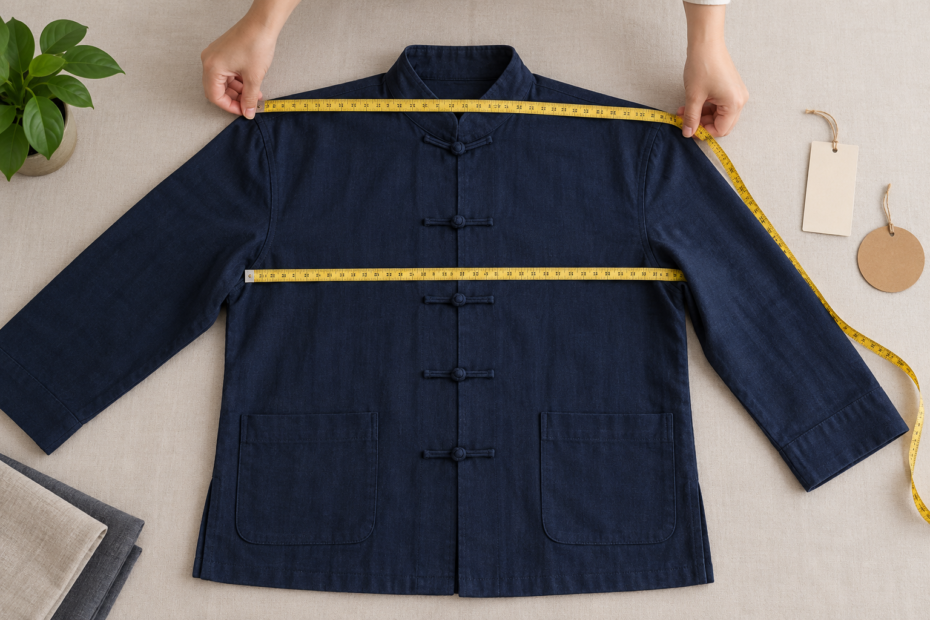
There is no universal conversion between “Asian” and US Tang suit sizes. A label such as L, XL, or 3XL can represent different finished measurements across sellers, factories, and patterns. Buyers should compare the garment’s shoulder, chest, midsection, sleeve, and back length with their body and a well-fitting jacket.
Why regional size labels are unreliable
“Asian size” and “US size” are broad retail descriptions, not one controlled standard. Two jackets carrying the same label can differ in chest, shoulder, sleeve, and length. A seller may also use a custom chart designed for one product line.
Treat the label as a reference within that seller’s chart only. Never add or subtract a fixed number of sizes without measurements.
Confirm whether the chart shows body or garment measurements
Body measurements describe the wearer. Finished-garment measurements describe the actual jacket. The garment must usually be larger at key points to provide wearing ease, but the amount depends on fabric, lining, cut, and preference.
If the chart says “chest 110 cm,” ask whether that is body circumference, finished jacket circumference, or a flat half-chest measurement. Comparing unlike values is a common ordering error.
Measure the body consistently
Measure chest at the fullest point, midsection where the jacket will close, shoulder width, sleeve length, and preferred back length while wearing the intended base layer. Keep the tape level and comfortably close without pulling it tight.
Record height and weight only as context. Two people with the same height and weight can have different shoulder, torso, arm, and midsection proportions.
Measure a jacket that already fits
Lay a comfortable jacket flat and use the seller’s stated method. Common points include shoulder seam to shoulder seam, chest from underarm to underarm, sleeve from shoulder point to cuff, and back length from collar base to hem.
Do not double a flat measurement unless the chart uses circumference. Photograph the tape placement so the seller can confirm that both parties measure the same way.
Prioritize the controlling measurement
The largest body area relative to the garment chart determines the minimum size. For one wearer, the shoulder may control; for another, the chest or midsection. Selecting by chest alone can leave sleeves too long or shoulders dropped.
If measurements fall across several sizes, ask about alteration or custom options. Simply choosing the largest size may distort collar, pocket, closure, and motif placement.
Compare shoulder width first
Shoulders influence how sleeves hang and are difficult to alter. A seam that sits far outside the shoulder can make the jacket collapse; one that sits too far inward can pull across the back.
Reach forward during fitting. The jacket should move without severe strain or excessive lifting at the hem.
Check chest and midsection separately
Tang jackets often fasten from collar to hem with frog closures, so both chest and midsection need adequate ease. Closures should lie flat without being pulled apart. A jacket that fits the chest may still bind while seated if the midsection is too small.
Test breathing, sitting, and reaching while fully fastened. Do not rely on an open-front photo.
Verify sleeve and jacket length
A wider size does not reliably provide the correct sleeve or torso length. Tall buyers may need longer proportions without extra width, while shorter buyers may find pockets and motifs too low after sizing up.
Confirm how sleeve length is measured because some charts start at the center back and others at the shoulder point. Compare like with like.
Account for fabric and lining
Non-stretch brocade may need more movement allowance than a soft or slightly flexible fabric. Full lining adds warmth and can restrict movement if cut too tight. The intended shirt or base layer also changes fit.
Verify composition, stretch, and lining rather than assuming from product photos.
Use centimeters and inches carefully
Keep one working unit throughout the comparison and only convert once. Rounding several times can change a close decision. Check whether a chart uses centimeters, inches, circumference, or flat width before copying values.
When in doubt, send the seller both the original measurements and your conversion.
Questions to ask the seller
- Are chart values body or finished-garment measurements?
- Is chest shown as circumference or flat width?
- How are shoulder, sleeve, and back length measured?
- How much variation is allowed in production?
- Which size suits the listed body and jacket measurements?
- Can the item be exchanged after trying it on?
- Will decoration limit alterations?
Final fitting test
- Wear the planned base layer.
- Fasten every closure.
- Check the collar and shoulder position.
- Sit, reach, walk, and use stairs.
- Photograph front, side, and back.
- Confirm the return window before altering or removing tags.
Review finished measurements on a dragon-embroidery Tang suit and a bamboo-leaf casual Tang shirt rather than assuming their labels convert equally. Browse the Panda-Tang shop, then visit Panda-Tang to verify current size charts, materials, stock, returns, and delivery.
 Français
 English