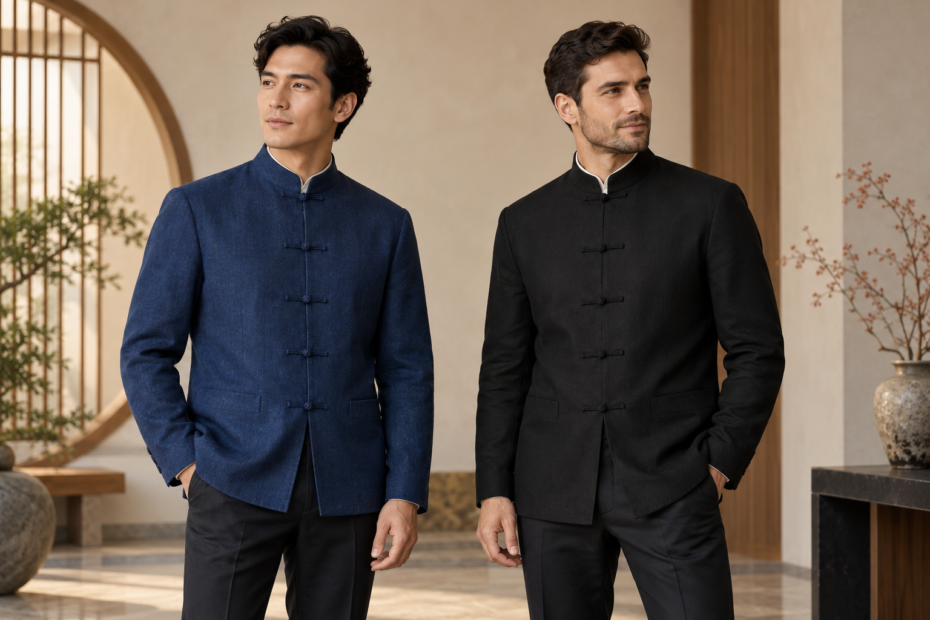
Blue Tang suits usually create a softer, more expressive formal look, while black Tang suits provide stronger contrast and a more restrained foundation. The right color depends on the event, host, lighting, fabric, accompanying trousers, and the wearer’s role rather than a universal color rule.
Start with the occasion
A wedding banquet, tea ceremony, business dinner, cultural program, festival, and casual celebration have different expectations. Confirm the invitation and ask the host when the dress code is unclear.
Black is often easier to place in conservative or evening settings. Deep navy or royal blue can work well when the event welcomes color, but brightness and fabric sheen change its apparent formality.
How blue changes the outfit
Deep navy can read almost as neutrally as black while revealing more surface detail. Medium or brighter blue attracts more attention and can feel celebratory or contemporary.
Color names are inconsistent across screens and sellers. Request daylight photographs or swatches when an exact wedding or group palette matters.
How black changes the outfit
Black creates a clean outline and lets frog closures, embroidery, or contrasting trim become the focal point. It also coordinates readily with black trousers and formal shoes.
On a dark stage or in low light, a black jacket can lose texture and separation. Subtle woven pattern, controlled sheen, or charcoal trousers can preserve definition.
Compare formality through fabric
Color alone does not establish dress level. A structured dark blue jacquard can appear more formal than a soft plain black cotton shirt, while a highly reflective black fabric may feel more festive than businesslike.
Verify fiber content, lining, weight, stretch, and care. Product photos cannot confirm silk, handwork, or comfort.
Account for venue lighting
Warm hotel lighting can make navy appear richer or nearly black. Cool daylight may reveal blue strongly, while camera flash can intensify sheen and woven patterns.
Photograph the full outfit in daylight, warm indoor light, and flash. Check it beside the partner’s or group’s clothing rather than judging the jacket alone.
Choose trousers and shoes
Black tailored trousers are the simplest partner for either color. Charcoal can separate a black jacket from the lower half, while tonal navy trousers require careful color matching.
Polished black lace-up shoes support formal events. Simple loafers can suit a less strict dinner or celebration when the trouser length and venue allow.
Coordinate without exact matching
A blue jacket can echo a small detail in another outfit or the event palette. A black jacket can act as a neutral frame when a partner’s clothing carries stronger color.
Exact matching is rarely necessary. Coordinating the level of formality, texture, and one repeated tone usually creates a more natural group appearance.
Check fit and movement
Fasten every closure and inspect the collar, shoulder, chest, midsection, sleeve, and back length. Blue and black garments with the same labeled size may use different patterns.
Sit, reach, greet, and walk in the planned base layer. A good color cannot compensate for pulling closures, dropped shoulders, or restricted movement.
Consider care and visible wear
Black may show lint, dust, and pale fibers. Blue can reveal uneven fading or abrasion, especially at cuffs and edges. Decorative fabric may require professional cleaning regardless of color.
Review care instructions before purchase and test any lint brush or steamer on an inconspicuous area.
Compare rewear value
A plain black Tang jacket can move between dinners, celebrations, and cultural events with minimal styling changes. Deep navy offers similar flexibility while feeling less severe.
Brighter blue may be more memorable but more dependent on the event palette. Choose based on real future occasions, not a theoretical versatility score.
Final decision checklist
- Confirm the host’s dress code and color expectations.
- View the actual fabric in more than one light.
- Compare finished measurements with a jacket that fits.
- Try the complete outfit with trousers and shoes.
- Check care, delivery, and return terms.
- Photograph front, side, and back before the event.
Choose black when restrained formality, simple coordination, and broad rewear are the priorities. Choose blue when the event welcomes a softer or more visible color statement, while still verifying the precise shade and fabric.
Compare a detailed dragon-embroidery Tang suit with a softer bamboo-leaf casual Tang shirt. Browse the Panda-Tang shop, then visit Panda-Tang to verify current measurements, materials, care, stock, returns, and delivery.
 Français
 English