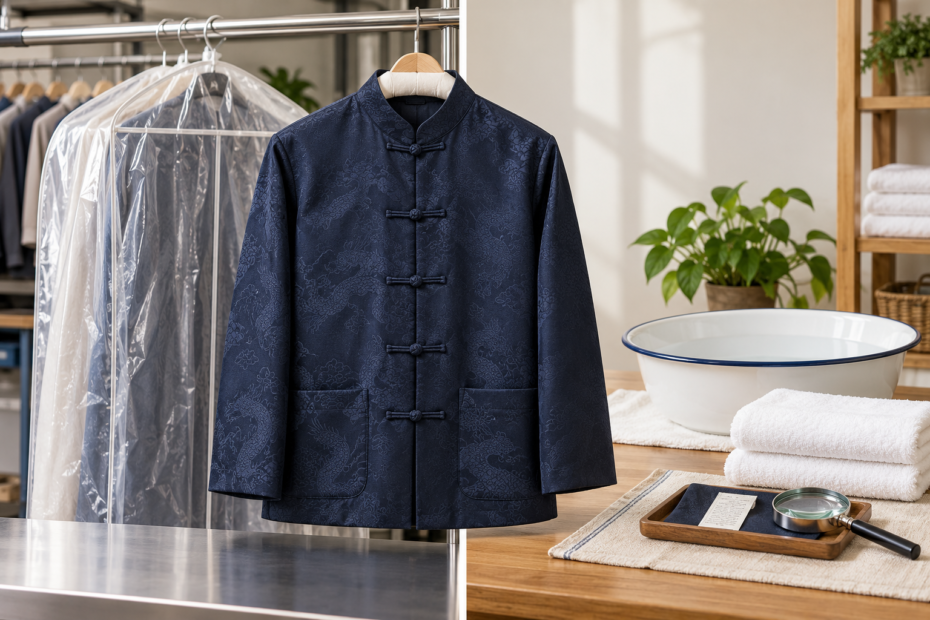
The sewn-in care label decides whether a Tang suit should be dry cleaned or hand washed. Dry cleaning may be safer for structured, lined, embroidered, or dry-clean-only garments; hand washing is an option only when the manufacturer explicitly permits it and the fabric, dye, trim, and construction can tolerate water.
Read the care label before anything else
Tang suits vary from washable casual shirts to structured brocade jackets. Their fiber content, lining, interlining, dye, embroidery, and frog closures can react differently to water and cleaning solvents.
If the label is missing, unclear, or contradictory, stop and ask the seller or a qualified cleaner. A general internet method cannot replace garment-specific instructions.
When professional dry cleaning may be appropriate
Choose a cleaner when the label says dry clean only, the jacket is structured or fully lined, decoration is complex, colors may bleed, or the garment has an oil-based stain.
Tell the cleaner about embroidery, delicate frog closures, metallic thread, loose trim, and the stain’s origin. Ask how those areas will be protected rather than assuming every shop uses the same process.
Limits of dry cleaning
Dry cleaning is not automatically harmless. Solvents, mechanical action, pressing, and repeated treatment can affect some finishes, trims, adhesives, or decorations.
Use a cleaner experienced with delicate formalwear and decorated garments. Bring the care label and request inspection before authorizing treatment.
When hand washing may be appropriate
Hand washing is reasonable only when the label allows it, the garment is unstructured or lightly constructed, and all components are compatible with water.
A washable casual Tang shirt may qualify, while a lined brocade jacket may not. Similar appearance does not mean identical care.
Test color and trim cautiously
When the label permits washing, inspect for loose threads, damaged frogs, and unstable decoration first. Follow any manufacturer test instructions for colorfastness.
Do not improvise a hidden-area test on a valuable garment if the result could leave a tide mark, color change, or finish damage. Seek professional advice instead.
Use gentle hand-washing technique only if allowed
Prepare clean cool or label-specified water and the permitted mild detergent. Support the garment fully, minimize soaking, and use gentle pressing rather than rubbing, twisting, scrubbing, or wringing.
Rinse according to the label, keeping the garment supported. Heavy wet fabric can stretch at shoulders, closures, and embroidered panels.
Drying matters as much as washing
Never assume a Tang suit can be tumble dried. Follow the label for flat drying, drip drying, or hanging, and reshape the garment while it is supported.
Keep it away from direct heat and strong sunlight unless the instructions expressly allow them. Do not store it until every layer is completely dry.
Treat stains by type
Blot fresh spills without spreading them and identify the substance before treatment. Water, oil, protein, dye, and unknown stains require different decisions.
Avoid household bleach, aggressive spot removers, and vigorous rubbing. Photograph the stain and tell the cleaner what has already been applied.
Protect frog closures and embroidery
Closures can snag, stretch, or become misshapen during cleaning. Embroidery can catch on rough surfaces or transfer color.
Fasten or protect components only as directed by the label or cleaner. Do not secure them with pins, tape, or rubber bands that can mark the fabric.
Pressing and steaming
Check the care label for temperature and steam limits. Use a pressing cloth when recommended and avoid crushing raised embroidery or applying an iron directly to decorative frogs.
A professional press may be safer for structured jackets. Test steam away from the garment first to prevent water spotting.
How often to clean
Clean when needed rather than after every brief wear, unless hygiene or the label requires otherwise. Airing in a clean shaded space and brushing with an appropriate garment brush may reduce unnecessary treatment.
Address stains promptly, but do not repeatedly clean a garment solely to make it smell strongly perfumed.
Final decision checklist
- Locate and follow the sewn-in care label.
- Identify fabric, lining, decoration, and stain type.
- Use a qualified cleaner for dry-clean-only or uncertain garments.
- Hand wash only when explicitly allowed.
- Avoid wringing, harsh chemicals, and unapproved heat.
- Make sure the garment is fully dry before storage.
Dry cleaning is generally the safer route for labeled, structured, lined, or heavily decorated Tang suits. Hand washing can suit explicitly washable casual garments, but the label and construction—not the garment category—make the decision.
Compare a detailed dragon-embroidery Tang suit with a softer bamboo-leaf casual Tang shirt. Browse the Panda-Tang shop, then visit Panda-Tang to verify current measurements, materials, care, stock, returns, and delivery.
 Français
 English