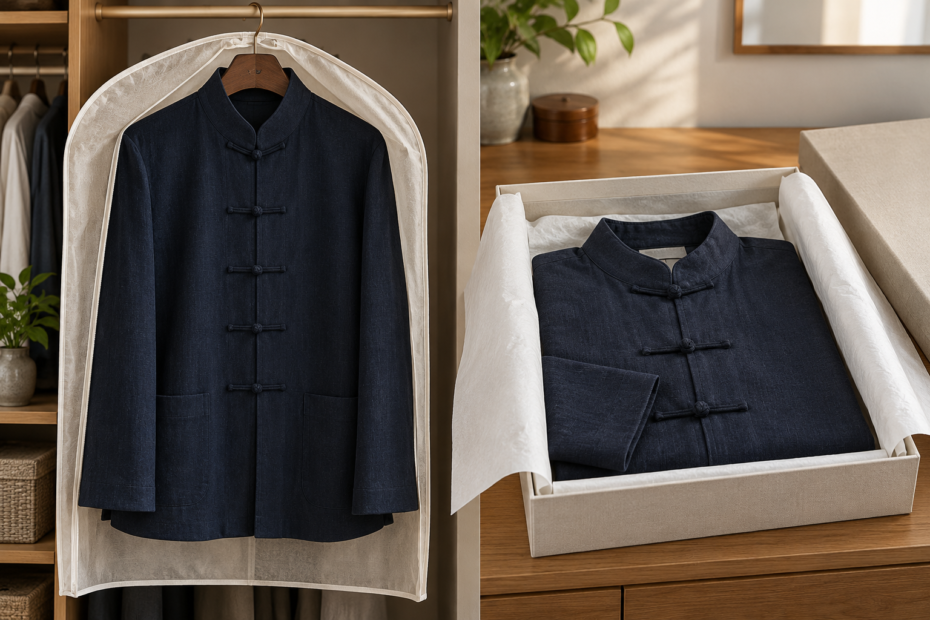
Hang a structured Tang jacket on a broad, supportive hanger when its weight and care instructions allow; fold a soft, heavy, delicate, or travel-ready garment when hanging could stretch it. In both cases, store the suit clean, completely dry, protected from light, and without crushing its frog closures or decoration.
Check the care label and construction
A tailored lined jacket, a soft casual shirt, a heavy embroidered coat, and a lightweight unlined top need different support. Read the care and storage guidance supplied with the garment.
If the material or construction is unknown, ask the seller or a textile-care professional. Do not assume all Tang suits can be stored the same way.
When hanging works best
Hanging helps a structured jacket retain its shoulder line and reduces hard fold creases. It is useful for frequently worn garments when the wardrobe has enough vertical and side clearance.
The jacket must not be so heavy or delicate that its own weight stretches the shoulders, collar, or decoration.
Choose the right hanger
Use a broad hanger that supports the shoulder width without extending into the sleeves. A padded or shaped hanger distributes weight more evenly than a thin wire hanger.
Fasten enough closures to keep the front aligned without placing them under tension. Keep neighboring garments from pressing the frogs or snagging embroidery.
Use a breathable cover
A clean breathable garment cover reduces dust while allowing air exchange. Confirm that the cover is colorfast and large enough not to compress the jacket.
Avoid long-term sealed plastic if it can trap residual moisture or contact delicate surfaces. Never store a garment in a dry-cleaning bag as a default long-term solution.
When folding works best
Folding can suit soft unstructured shirts, very heavy pieces that might stretch, delicate decoration that needs controlled support, travel, or wardrobes without adequate hanging space.
It also protects a garment from shoulder distortion when the fold is loose, supported, and periodically changed.
Fold without crushing details
Close the garment gently, smooth it on a clean surface, and place clean acid-free tissue where needed to soften folds and protect raised components. Keep frog closures and embroidery from pressing directly against each other.
Use a roomy box or shelf rather than a tight stack. Heavy items should never sit on top of the Tang suit.
Prevent permanent creases
Place folds away from rigid embroidery, appliques, collar edges, and decorative closures. Avoid sharp compression at the same points for months.
Refold along different lines periodically if long-term folded storage is necessary, always handling the garment with clean dry hands.
Control the storage environment
Choose a cool, dry, clean, and dark location with stable conditions. Keep garments away from direct sunlight, heaters, damp walls, kitchens, bathrooms, and attic or basement extremes.
Moisture encourages odor and damage, while prolonged light can fade dyes unevenly. Inspect the wardrobe rather than relying only on fragrance products.
Moth and pest precautions
Store only clean garments because residue can attract pests. Inspect seams, pockets, boxes, and the wardrobe on a regular schedule.
Use pest-control products only as directed and prevent direct contact with the fabric unless the product and garment instructions permit it. Keep such products away from children and pets.
Travel storage
For short travel, use a garment bag for a structured jacket or a loose supported fold for a soft shirt. Pack it last and remove it promptly on arrival.
Do not vacuum-compress a structured or embroidered Tang suit. Allow time for safe hanging, label-approved steaming, or professional pressing before the event.
Inspect before and after storage
Check for stains, loose threads, damaged closures, insects, odor, moisture, and color transfer before putting the garment away. Repair small problems before they worsen.
At the start of each season, air the suit in a shaded clean place and reassess the hanger, tissue, cover, and storage area.
Final decision checklist
- Clean the garment according to its label.
- Make sure every layer is completely dry.
- Choose support based on structure and weight.
- Protect closures and decoration from pressure.
- Use a clean, dark, stable storage environment.
- Inspect and refold or reposition the garment periodically.
Hanging is usually best for structured jackets that need shoulder support and are not too heavy. Folding is often better for soft, heavy, delicate, or travel-stored pieces, provided the folds are cushioned and the garment is not compressed.
Compare a detailed dragon-embroidery Tang suit with a softer bamboo-leaf casual Tang shirt. Browse the Panda-Tang shop, then visit Panda-Tang to verify current measurements, materials, care, stock, returns, and delivery.
 Français
 English