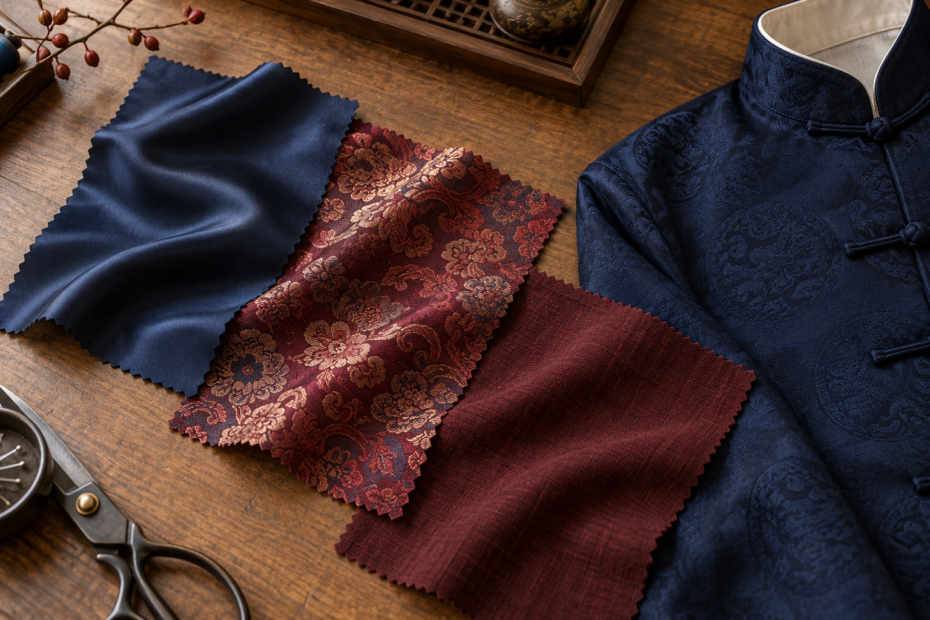
Silk, brocade, and cotton are not three equivalent fabric categories: silk and cotton are fibers, while brocade is a patterned weave that can use silk, cotton, synthetic fibers, or blends. To choose a Tang suit, confirm both fiber content and fabric construction, then compare drape, sheen, weight, lining, care, climate, and intended use.
Read the fiber label and fabric description separately
A product may be silk brocade, synthetic brocade, a cotton blend, or a smooth fabric marketed as “silk-like.” The word brocade does not reveal the fiber, and shine does not prove silk.
Request the shell and lining composition in percentages when available. If the listing is vague, treat the material as unconfirmed rather than filling the gap from appearance.
What silk can offer
Silk fibers can produce fabrics with fluid drape, subtle luster, and a refined hand, although properties vary greatly by weave, weight, finish, and blend. A silk Tang suit may feel elegant for formal events, but the actual garment can be crisp, soft, light, or substantial.
Silk can require careful cleaning and storage. Follow the garment label, protect it from abrasion and prolonged strong light, and confirm whether steaming or ironing is permitted.
What brocade can offer
Brocade uses woven patterning that can create raised detail, color contrast, and visual depth. It often supports a ceremonial or statement look, especially when motifs and metallic threads are prominent. Dense brocade may also feel warm or structured.
Inspect motif alignment at the front, seams, pockets, and sleeves. Confirm fiber content, lining, weight, and snag risk because the weave name alone cannot predict comfort or care.
What cotton can offer
Cotton fabrics often provide a matte appearance and can suit casual Tang shirts, warm-weather wear, or repeated use. Breathability, softness, wrinkling, shrinkage, and durability depend on weave, weight, finish, and whether the fabric is blended.
Do not assume every cotton garment is lightweight or machine washable. A dense cotton jacket may be substantial, and decorative closures or lining can change the care method.
Compare drape and structure
A fluid fabric follows the body and can create a softer silhouette. A firm brocade or dense cotton can hold the standing collar and front line more sharply. Neither effect is universally better.
Choose structure for a crisp formal outline and drape for relaxed movement, then test whether the pattern provides enough ease. Fabric cannot correct an unsuitable cut.
Compare sheen and photography
Smooth silk fabrics and metallic brocades can reflect strongly under flash, while cotton usually reads more matte. Event lighting can make deep colors look brighter or create glare that is absent in the product photo.
Photograph a sample in daylight, warm indoor light, and flash. Decide whether the surface supports the occasion and whether small wrinkles become visible.
Compare warmth and lining
Fiber influences comfort, but fabric density and lining may matter more than the fiber name alone. A lightweight silk fabric can feel cooler than dense brocade; a heavy cotton jacket can feel warmer than a loosely woven blend.
Ask for weight or seasonal guidance only when the seller can verify it. Consider venue temperature, wear duration, and the intended base layer.
Compare durability and snagging
Durability depends on yarn, weave, abrasion, seam construction, cleaning, and use. Raised brocade patterns can catch on rough surfaces. Smooth fine fabrics may show pulls, while cotton can crease or fade depending on treatment.
Inspect high-contact areas such as cuffs, closure attachments, pocket edges, and underarms. A sample or close photograph is more useful than a general “premium” claim.
Compare care requirements
Read the sewn care label and seller instructions before purchase. Some garments require professional cleaning because of lining, interfacing, embroidery, or mixed materials even when the shell fiber seems washable.
Never apply a generic silk, brocade, or cotton cleaning method to a finished Tang suit without checking its construction. Test any spot treatment in an inconspicuous area if the manufacturer permits it.
Choose by occasion
- Formal wedding or banquet: silk or richly woven brocade may provide visual depth when fit and care are suitable.
- Smart casual: matte cotton or a restrained blend can be easier to combine with everyday trousers.
- Stage performance: prioritize movement, visibility, seam strength, and care over fiber prestige.
- Travel: consider wrinkling, packing, cleaning access, and replacement risk.
Questions to ask before ordering
- What are the shell, lining, and trim fibers?
- Is the pattern woven, printed, embroidered, or applied?
- What is the fabric weight and stretch?
- Is the garment fully, partially, or unlined?
- What care method does the sewn label require?
- Can the seller provide a swatch or sample?
- Does the surface snag or reflect strongly?
Compare the surface detail of a dragon-embroidery Tang suit with the quieter appearance of a bamboo-leaf casual Tang shirt, while verifying each current product description. Browse the Panda-Tang shop and visit Panda-Tang for measurements, materials, care, stock, returns, and delivery.
 Français
 English