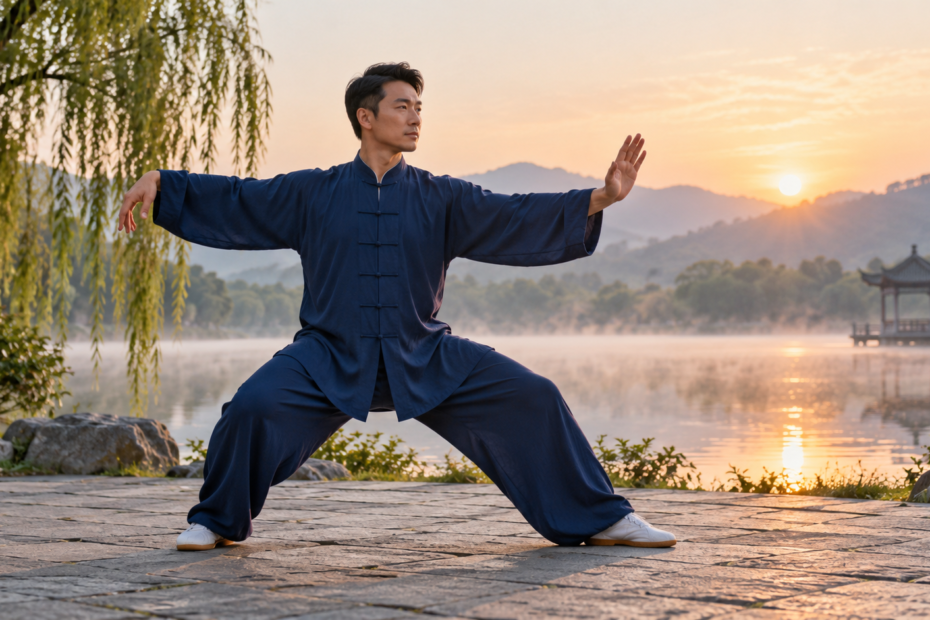
A Tai Chi Tang suit should be chosen for unrestricted movement first and appearance second. The shoulders must allow rounded arm positions, trousers must support wide stances, and closures must remain secure without pressing the body. A decorative event jacket is not automatically suitable for regular practice.
Confirm the intended use
Ask whether the outfit is for daily training, a demonstration, competition, photography, teaching, or travel. Regular practice favors easy care and durability. Performance may require a specific color or visual line. Always check instructor or event rules before purchasing.
Measure for dynamic movement
Record chest, waist, hip, shoulder, sleeve, upper arm, thigh, rise, and inseam. Compare these with finished-garment measurements. Static ease is not enough: the outfit must work while reaching, turning, sinking into stance, and shifting weight.
Test the shoulders and sleeves
Raise both arms, round them forward, extend sideways, and rotate the torso. The jacket should not bind across the upper back or lift excessively. Sleeves should not cover the hands or pull tight at the elbow. Wide sleeves create flow but can interfere if excessively long.
Check trousers in low and wide positions
Front and back rise, hip, thigh, and crotch construction matter as much as waist. Test a comfortable wide stance, controlled squat, step, and weight transfer. Elastic or drawstring waists can offer flexibility, but verify the relaxed and maximum dimensions.
Choose fabric by practice conditions
Ask about fiber content, weight, stretch, opacity, and care. Lightweight fabric may suit warm outdoor practice; a heavier cloth may drape more visibly in demonstrations. Neither is universally best. Avoid assumptions based on “silk” appearance and check whether the surface becomes slippery, clingy, or transparent with movement.
Inspect closures and seams
Frog closures should be secure and flat. For vigorous or repeated training, reinforce weak points before they fail. Inspect underarm, side, and trouser-crotch seams because these areas take movement stress. Decorative embroidery should not make the inside rough against skin.
Separate training wear from statement wear
A highly decorated jacket may suit a photograph or ceremony but be impractical for frequent washing. The dragon-embroidery Tang suit demonstrates a strong visual direction, while the bamboo-leaf casual Tang shirt suggests a quieter option. Verify whether any product is intended for your actual activity rather than relying on its name.
Plan footwear and hem length
Use footwear recommended by the instructor and appropriate to the training surface. Trousers should clear the heel and not catch underfoot during stepping. Test hems after choosing shoes, and consider whether ankle cuffs are required or preferred.
Movement test before keeping
- Warm up in the planned base layer.
- Fasten all closures.
- Perform the highest reach and widest comfortable stance.
- Turn, step, shift weight, and sit.
- Check seams, collar, cuffs, and trouser hem.
- Repeat long enough to assess temperature and friction.
Stop if clothing interferes with safe movement, and consult the instructor about activity-specific requirements. Style cannot compensate for restricted motion.
Final decision
Choose the outfit that passes the real practice sequence, suits the climate, and can be cleaned at the needed frequency. Browse the Panda-Tang shop, then visit Panda-Tang to confirm measurements, intended use, fabric, care, returns, stock, and delivery before ordering.
 Français
 English