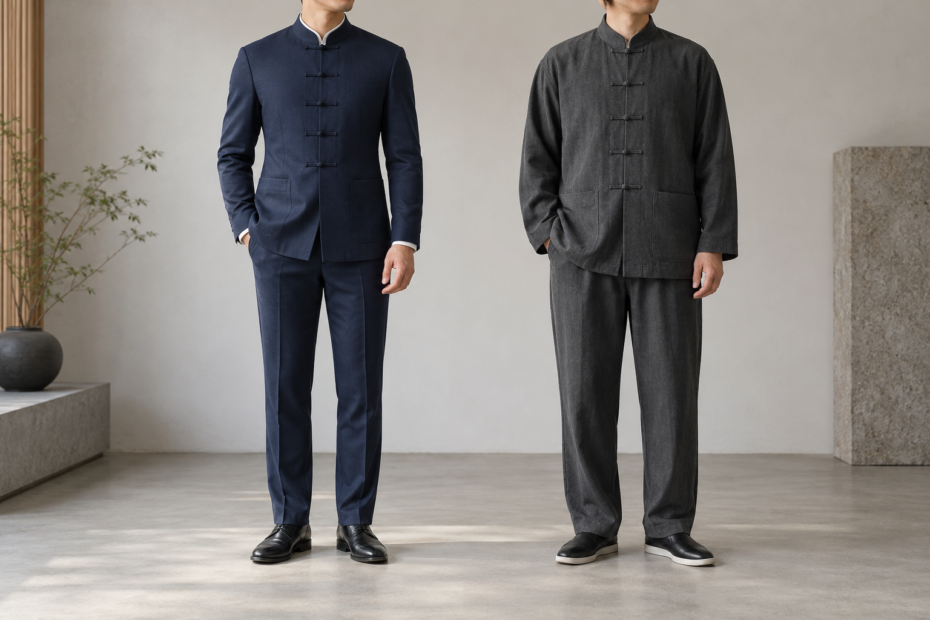
A tailored Tang suit fit creates a sharper outline for formal settings, while a relaxed fit prioritizes ease, layering, and casual movement. The right choice depends on the wearer’s proportions, fabric, occasion, base layer, and activity. “Tailored” should not mean tight, and “relaxed” should not mean buying a size with incorrect shoulders.
Define fit by measurements, not labels
Retailers use slim, tailored, regular, and relaxed inconsistently. Compare finished shoulder, chest, midsection, sleeve, upper arm, back length, and hem measurements with a garment that already fits.
Confirm whether the size chart lists body or finished-garment dimensions. The difference between them provides wearing ease, but the required amount varies with fabric and design.
How a tailored fit should look
A tailored Tang jacket usually has a controlled shoulder, moderate waist shaping, cleaner sleeves, and less excess fabric at the sides. Frog closures should remain flat, and the front edges should not pull apart.
The wearer must still sit, breathe, reach, and raise the arms comfortably. Horizontal strain at the chest or midsection is a sign of insufficient room, not a successful tailored look.
How a relaxed fit should look
A relaxed jacket provides more room through the body and sleeves, often with a straighter outline. It can suit casual wear, layering, movement, or a wearer who dislikes close tailoring.
Shoulders and collar still need to fit deliberately. Simply sizing up can drop the shoulder seams, lengthen the sleeves, lower the pockets, and move the closures away from their intended positions.
Compare shoulder balance first
The shoulder is difficult to alter and controls how the sleeve hangs. In either fit, seams should follow the design rather than collapse or pull. A relaxed cut may intentionally extend the shoulder, but the extension should be consistent and allow movement.
Reach forward and inspect the upper back. Severe pulling, collar lift, or excessive bunching indicates a mismatch.
Compare chest and midsection ease
A tailored fit follows the torso without making closures carry tension. A relaxed fit leaves more visible room, but the front should remain level and the hem should not swing unevenly.
Fit the largest controlling measurement. If shoulders require one size and the midsection another, ask about alteration or custom sizing rather than accepting distortion.
Compare sleeves and armholes
Tailored sleeves are usually cleaner and narrower, while relaxed sleeves allow more volume. Both need enough upper-arm room and a well-shaped armhole. An excessively low armhole can lift the entire jacket during movement.
Check sleeve length while standing, reaching, and bending the elbow. Decorative cuffs or piping may limit adjustments.
Compare jacket length and trouser balance
A fitted contemporary jacket often works with tailored straight or gently tapered trousers. A longer relaxed jacket may look more balanced with straight trousers and a slightly fuller leg.
The jacket should cover the waistband through normal movement. Set trouser length with the final shoes and judge the entire silhouette rather than each piece separately.
Fabric changes the result
Firm brocade or structured fabric can make a relaxed cut appear larger, while a soft cloth may drape closer to the body. A tailored cut in rigid fabric needs enough movement allowance; a soft tailored jacket may show body contours more clearly.
Confirm composition, weight, lining, stretch, and care. Product photos cannot prove how fabric behaves during wear.
Choose for the occasion
- Formal wedding or banquet: a tailored fit usually creates a polished line if it remains comfortable.
- Smart casual: either fit can work; use fabric and trousers to set formality.
- Travel or long seated event: prioritize collar comfort, sitting ease, and wrinkle behavior.
- Performance or movement: choose a purpose-appropriate cut and test the complete routine.
Consider layering and climate
A tailored jacket should be fitted over the actual base layer. Adding a thick shirt later can change collar, chest, and sleeve comfort. A relaxed fit offers more layering room but may feel warm when fully lined.
Test the complete outfit at the expected indoor or outdoor temperature whenever possible.
Know what a tailor can change
Sleeve and hem adjustments may be possible, while shoulders, armholes, collar, closure placement, and large motifs are more complex. Lining, piping, embroidery, and patterned fabric can increase alteration difficulty.
Have a tailor inspect the garment before purchase or before the return deadline if significant changes are expected.
Use a movement and appearance test
- Wear the intended base layer and trousers.
- Fasten every closure.
- Check front, side, and back photographs.
- Sit for ten minutes.
- Reach forward, overhead, and across the body.
- Walk and use stairs.
- Choose the fit that stays balanced without pressure or excess movement.
Compare the structured presentation of a dragon-embroidery Tang suit with the softer impression of a bamboo-leaf casual Tang shirt. Browse the Panda-Tang shop, then visit Panda-Tang to verify current measurements, materials, care, stock, returns, and delivery.
 Français
 English