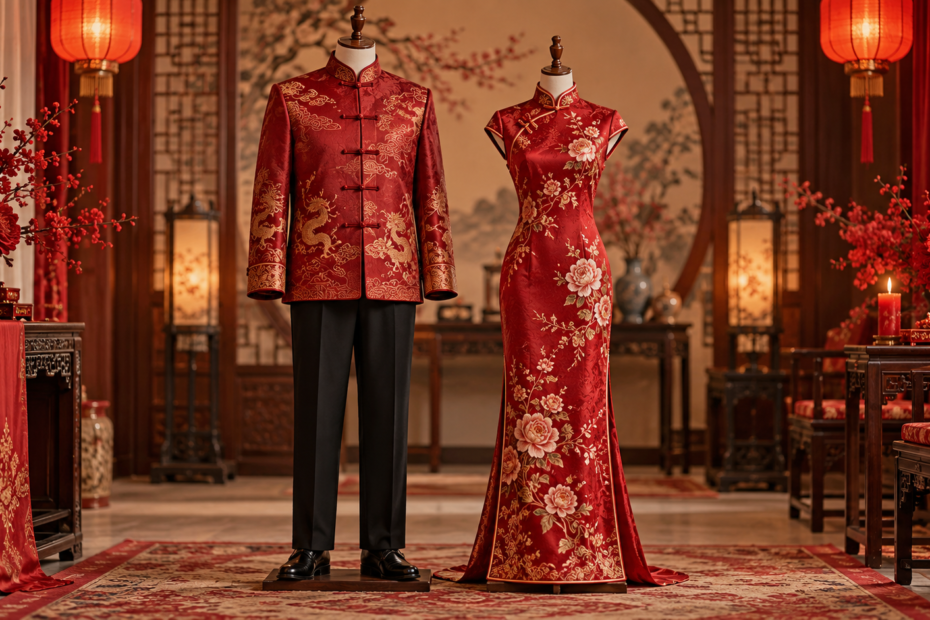
The best Tang suit and qipao pairing looks coordinated, not copied. Match the couple’s level of formality, choose one shared color or visual detail, and let each garment keep its own silhouette. This approach works for weddings, engagement photographs, Lunar New Year celebrations, anniversaries, tea ceremonies, and cultural events without turning both outfits into a single matching costume.
Use the checklist below before ordering. Traditions and event expectations differ among families and communities, so confirm important colors, motifs, and ceremony requirements with the hosts rather than relying on a generic internet rule.
1. Define the occasion and roles
Start by writing down the event, venue, season, and each wearer’s role. A wedding couple may need a higher level of ceremony than wedding guests. A family New Year portrait can support richer color than a business reception. A tea ceremony may involve kneeling, serving, and repeated sitting, while a photo session prioritizes the front and side views.
Ask whether the outfits must work for the entire day or only one segment. Changing after a ceremony permits more decorative garments; wearing the same pieces through travel, meals, and dancing calls for greater comfort and simpler care.
2. Choose coordination, not identical fabric
There are four dependable ways to connect the outfits:
- Shared color: repeat one red, navy, gold, ivory, or black tone while allowing different patterns.
- Shared motif family: use compatible botanical, geometric, cloud, or other design language at different scales.
- Shared trim: echo piping, metallic thread, or button color.
- Shared formality: pair matte with matte or ceremonial sheen with similarly elevated fabric.
Avoid demanding an exact color match from separate screens or sellers. Dye lots, lighting, and textile texture change perceived color. Request daylight photos or order with a return window when exact coordination matters.
3. Select the lead garment
Choose the garment with the stronger motif or stricter fit requirements first. A fitted qipao may establish the palette because its collar, bust, waist, hip, and length all require careful decisions. Alternatively, an embroidered Tang jacket may be the visual anchor if it has a large dragon or another dominant design.
Once the lead is chosen, make the second garment supportive. If the qipao carries dense floral embroidery, a solid or subtly patterned Tang jacket usually creates balance. If the Tang jacket has a bold motif, a qipao with quieter texture can prevent visual competition.
4. Align the formality level
A casual cotton or linen-look qipao may feel mismatched beside a high-shine brocade Tang jacket. Likewise, a heavily embellished floor-length qipao can overpower a simple everyday shirt. Compare fabric sheen, embroidery density, collar crispness, garment length, and shoe formality together.
For Tang style references, the dragon-embroidery Tang suit represents a strong statement, while the bamboo-leaf casual Tang shirt offers a more restrained visual direction. Verify current colors and specifications on the product pages.
5. Test fit independently
Coordination cannot rescue poor fit. For the Tang jacket, check shoulder width, chest, waist, sleeve, back length, and closure alignment. For the qipao, follow the maker’s measurement requirements and consider bust, waist, hip, shoulder, neck, total length, slit, and intended heel height. Finished-garment dimensions need wearing ease beyond body dimensions.
Both wearers should sit, reach, walk, and use stairs. Test any ceremony movements. A qipao slit and hem must allow a natural stride without revealing more than intended; a Tang jacket must remain smooth when seated and should not press at the neck. Arrange tailoring early because decorative edges and embroidery can limit alteration options.
6. Plan colors with the setting
Red is a popular celebratory choice, but it is not the only coherent palette. Navy with silver, black with restrained gold, ivory with burgundy, or complementary jewel tones can photograph well. Check the venue walls, flowers, stage lighting, and wedding-party colors. Guests should confirm whether red, white, black, or another color has a special restriction for that particular event.
View both garments together in daylight and the likely venue light. Photograph them with and without flash. Glossy fabrics can appear brighter and embroidered thread can reflect more strongly than expected.
7. Coordinate accessories sparingly
Select shoes only after confirming garment lengths. Keep socks unobtrusive with the Tang suit and test qipao footwear for standing time as well as photographs. One shared detail—a pocket square color, jewelry metal, or subtle hair ornament—is usually enough. Avoid adding multiple generalized “Asian” props that have no connection to the event.
If carrying bouquets, tea ware, or gifts, include those colors in a test photograph. Accessories should not catch on frog closures, embroidery, or delicate fabric. Have a small care kit with a lint roller, stain cloth, safety pins, and any maker-recommended fastening supplies.
8. Build a realistic timeline
- Confirm event expectations and budget.
- Choose the lead garment and obtain accurate measurements.
- Select the supporting garment from verified dimensions.
- Allow shipping, inspection, and exchange time.
- Complete alterations before the final week.
- Conduct a full dressed rehearsal with shoes and accessories.
- Steam or press according to each care label and transport garments properly.
Do not schedule a first fitting on the event morning. Online size labels are inconsistent, custom work needs buffer time, and colors can differ from screens. A calm planning window produces a more respectful and polished result.
Final couple’s checklist
- Our garments match in formality, not necessarily in pattern.
- One shared color or detail connects the pair.
- Both outfits pass sitting, walking, and ceremony movement tests.
- The colors suit the venue and the hosts’ expectations.
- Shoes, accessories, care, and delivery timing are confirmed.
- We can describe the garments accurately without exaggerated claims.
When these boxes are checked, the couple will look intentionally connected while each person remains comfortable and distinct. Browse the Panda-Tang shop for current men’s options, then visit Panda-Tang to confirm measurements, availability, care, and delivery before ordering.
 Français
 English