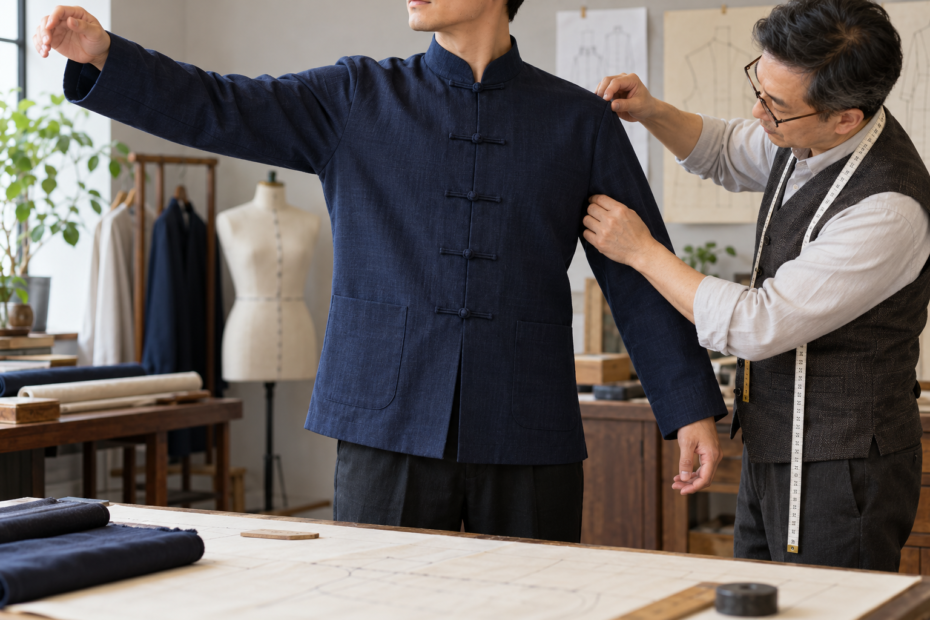
Tang suit jacket comfort depends on how the pattern, fabric, lining, collar, sleeves, and closures work together—not simply on choosing a larger size. A jacket can look correct while standing yet pull across the back, press at the neck, or ride up when the wearer reaches forward. Evaluating construction through real movement is therefore as important as checking the size chart.
Start with the shoulder and upper back
The shoulder establishes where the sleeve hangs and how force travels when the arm moves. A seam that sits far beyond the shoulder may create a relaxed look, but it can also cause excess fabric and restrict a close-fitting armhole. A seam that sits too far inward can pull across the upper back.
Fasten the jacket and reach both arms forward as if holding a steering wheel. Moderate movement in the back is normal; sharp horizontal strain lines, a collar that lifts, or a hem that rises dramatically indicate insufficient room or an incompatible pattern. Sizing up may add chest width but can also drop the shoulders, so compare finished shoulder, chest, and back measurements together.
Why armhole shape matters
Armhole depth and shape influence mobility more than many shoppers expect. A well-shaped, relatively close armhole can allow the sleeve to move with the arm. An excessively low armhole may pull the whole jacket upward when the wearer raises a hand.
Construction varies by garment, so do not judge from the size label alone. Test reaching overhead, crossing the arms, and extending them forward. The wearer should be able to complete ordinary actions without the front closures carrying all the strain.
Check sleeve pitch, width, and cuff design
Sleeve pitch describes the angle at which the sleeve is set into the jacket. If it differs greatly from the wearer’s natural arm position, twisting or diagonal wrinkles can appear even when the sleeve circumference is adequate. Upper-arm width also needs enough ease for the intended base layer.
Decorative piping, embroidery, or shaped cuffs may limit alteration options. Check sleeve length with arms relaxed and extended. A sleeve that looks ideal in a formal pose may become too short during greetings, dining, or performance movements.
Evaluate the standing collar while seated
A standing collar should remain centered and comfortable without pressing the throat. Its height, circumference, stiffness, seam allowance, and fastening position all affect comfort. A heavily structured collar can create a crisp outline but may feel restrictive for a wearer with a shorter neck or a forward head posture.
Fasten the top closure, turn the head, look down, and sit for several minutes. If the collar rubs, gaps because the chest is pulling, or forces the wearer to leave it open, a different size or collar construction may be more suitable.
Understand frog closures and front balance
Frog closures create the characteristic front line of many Tang jackets. They should align evenly and lie flat without being stretched apart. Because small loops can be slower to operate, buyers should test finger access and the force needed to fasten each one.
Some jackets may use hidden snaps or other support behind decorative frogs, while others rely on the frogs alone. Verify the actual product rather than assuming. Front edges that overlap unevenly or swing apart may indicate poor balance, incorrect sizing, or a construction problem.
Fabric controls drape, heat, and recovery
Dense woven fabrics can support a defined collar and smooth front, but they may feel warmer and resist large movements. Softer fabrics can drape comfortably yet show wrinkles or lose a sharply tailored line. Stretch, if present, should supplement a good pattern rather than compensate for an undersized garment.
Confirm fiber composition, fabric weight, surface texture, and care from the seller. Product photography cannot reliably prove breathability, softness, or stretch. A base layer also changes how the jacket slides over the body.
Lining changes friction and ventilation
A full lining can help a jacket move over a shirt and protect interior seams, but it can also add warmth. Partial lining may improve ventilation while exposing more seam finishing. A tight lining can restrict movement even when the outer fabric appears roomy.
Inspect the lining during a reach test. It should not pull sharply at the armholes or back. Ask whether the sleeve and body use the same lining material, and follow the care label because shell and lining may react differently to cleaning.
Length, vents, and pockets affect daily movement
A longer jacket provides coverage but may bunch in the lap or catch when the wearer sits. Side vents can provide room around the hips, although their effectiveness depends on placement and width. Pockets should remain accessible without pulling the front out of alignment.
Sit fully back in a chair, climb steps, bend to tie a shoe, and place normal items in the pockets. These actions reveal problems that a front-facing photo cannot show.
Use a practical movement test
- Wear the intended shirt or base layer.
- Fasten every closure and check breathing room.
- Turn the head and sit for at least five minutes.
- Reach forward, overhead, and across the body.
- Walk, use stairs, and place items in the pockets.
- Photograph the front, side, and back after movement.
- Check for pressure, rubbing, twisting, and closures under strain.
Complete this test before removing tags or altering the garment. If the jacket is intended for martial arts, stage work, or another demanding activity, test the exact movement pattern and choose a construction designed for that use.
How to compare current styles
Use close product views to compare the structure and decoration of the dragon-embroidery Tang suit with the more casual presentation of the bamboo-leaf Tang shirt. Confirm current measurements, materials, lining, and care on the individual page rather than inferring comfort from appearance.
Browse the Panda-Tang shop to compare available silhouettes, then visit Panda-Tang to review the latest size, stock, returns, and delivery information before ordering.
 Français
 English