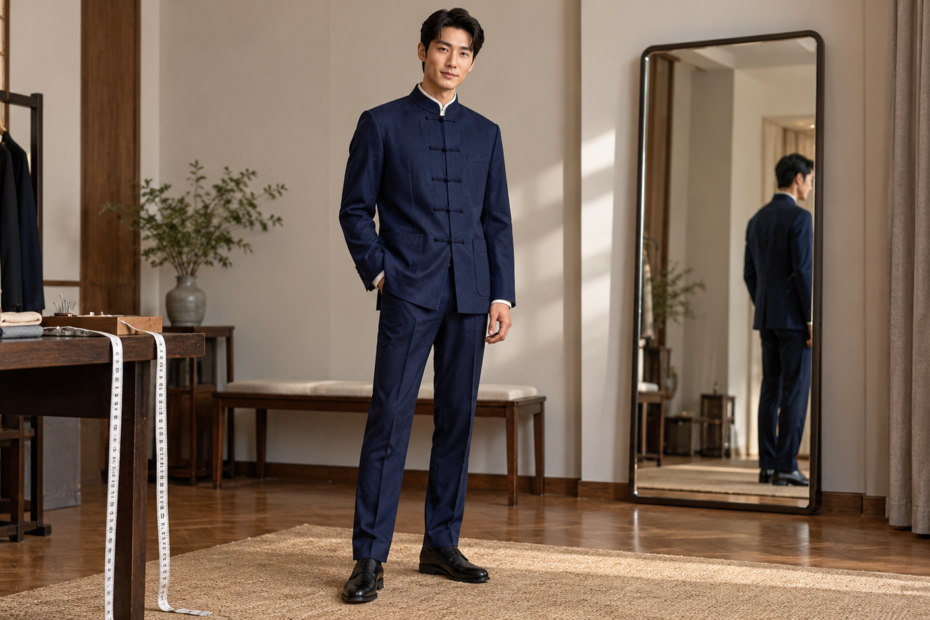
A tall man’s Tang suit should be chosen by vertical and horizontal garment measurements together. Extra chest room does not guarantee enough sleeve or jacket length, and simply sizing up can create dropped shoulders and excess width. The goal is balanced proportion: correct shoulder placement, adequate reach, a useful jacket length, and trousers with the right rise and inseam.
Height alone is not a size
Two men of the same height can have different torso, arm, shoulder, and leg proportions. Record height for context, then measure chest, waist, hip, shoulder width, sleeve, back length, trouser rise, and inseam. Measure over the clothing intended for the event.
Compare the body with a jacket and trousers that already fit. Ask whether the seller’s chart lists body dimensions or finished-garment dimensions. Finished measurements need enough ease for breathing, sitting, and reaching.
Protect the shoulder fit first
The shoulder seam should sit near the shoulder edge. Buying a wider size only to gain sleeve length may cause the seam to drop, the chest to balloon, and the closures to shift. Shoulder reconstruction is more involved than a simple hem alteration, so prioritize the shoulder and ask whether long sizing or made-to-measure options exist.
Reach both arms forward during fitting. The jacket should move without severe pulling across the upper back or lifting dramatically at the hem.
Verify sleeve length with the arms moving
Measure from the shoulder point to the wrist using the seller’s stated method. Some charts measure from center back, so never compare unlike methods. Check sleeve length while standing naturally and while reaching. A sleeve that looks adequate at rest may expose too much forearm during greetings, driving, or photographs.
Inspect cuff decoration before planning alterations. Embroidery, piping, or shaped cuffs can make shortening or lengthening difficult, and there may be little hidden fabric allowance.
Choose a balanced jacket length
A jacket that is too short can make the torso appear cut off and may rise above the waistband when seated. A very long jacket can distort pocket and frog-closure placement if it was merely sized up rather than proportioned for height. Ask for back length from the base of the collar and compare it with a favored jacket.
Check where the lowest closure, pockets, side vents, and motifs sit on the body. Proper length is about design placement as well as coverage.
Do not overlook trouser rise and inseam
If the Tang suit is sold as a set, confirm waist, hip, front rise, back rise, thigh, inseam, and hem width. A longer inseam cannot compensate for a rise that is too short. Sitting comfort and waistband position should be tested before deciding trouser length.
Ask whether trousers have extra hem allowance. Complete alterations with the final shoes because footwear changes the desired break.
Use pattern and closure placement carefully
Large motifs can look balanced on a longer frame when their position is designed for it. Randomly extending a garment may leave embroidery too high or create empty areas. Frog closures should remain evenly spaced and lie flat from collar to hem.
For visual references, compare a detailed dragon-embroidery Tang suit with a restrained bamboo-leaf Tang shirt. Verify actual garment measurements on the current product page rather than inferring fit from the model.
Ask these questions before ordering
- Are chart values body or finished measurements?
- How is sleeve length measured?
- What is the back length from collar base?
- Are tall or custom proportions available?
- Is there hem or sleeve allowance for tailoring?
- Will decoration limit alterations?
- What is the exchange policy and timeline?
Complete a full wear test
- Fasten the collar and every frog closure.
- Check shoulder seams and sleeve reach.
- Sit, stand, turn, and climb stairs.
- Confirm the jacket covers the waistband through movement.
- Test trouser rise and stride.
- Photograph front, side, and back.
Do this before removing tags. If alterations are needed, ask a tailor to assess the decorative construction in person.
Final ordering rule
Choose the size or service that matches shoulders, sleeve, torso length, rise, and inseam without relying on added width. A well-proportioned simple garment will look stronger than an ornate one stretched beyond its intended block.
Review options in the Panda-Tang shop and visit Panda-Tang to confirm measurements, alteration limits, stock, returns, and delivery.
 Français
 English