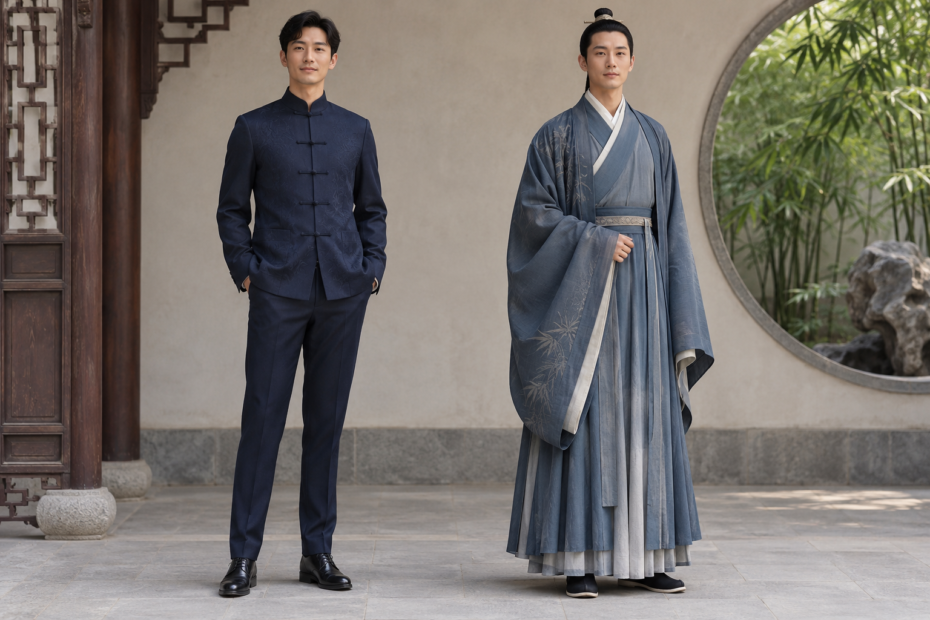
A modern Tang suit is usually a jacket-and-trouser outfit with a standing collar and frog closures, while hanfu refers to a broad family of historical Chinese clothing traditions with many periods, forms, layers, and wearing methods. Choose by the event’s stated category, historical requirements, host guidance, and the wearer’s ability to dress and move correctly.
The categories are not interchangeable
The contemporary garment sold as a Tang suit or tangzhuang is not simply clothing from the Tang dynasty. It commonly describes modern Chinese-inspired jackets that developed through later influences and contemporary tailoring.
Hanfu is an umbrella term, not one fixed robe. Its forms vary by historical period, gender conventions, region, construction, and modern reconstruction practice.
Compare the silhouettes
A Tang suit commonly uses a hip-length jacket, standing collar, frog closures, set-in sleeves, and separate trousers. It fits into a familiar modern menswear outline.
Hanfu ensembles may use cross collars, wrapped fronts, wide sleeves, long robes, skirts, belts, layered garments, or other period-specific structures. One example cannot represent the entire category.
Match the event description
A Tang suit can suit banquets, family celebrations, cultural programs, formal dinners, and modern weddings when the host approves.
Hanfu is often chosen for historical reenactment, hanfu gatherings, themed photography, selected ceremonies, performances, or cultural events that specify an ensemble or period. Follow the organizer’s terminology.
Historical accuracy requirements
If an event names a dynasty, period, reconstruction standard, or character, a generic Tang suit will not satisfy that historical brief.
A hanfu outfit also needs more than a robe-shaped appearance. Pattern, collar, layering, fabric, accessories, hairstyle, and footwear may all be part of the requested standard.
Ease of dressing
A Tang jacket is usually fastened like a modern garment and paired with conventional trousers, making it relatively straightforward for first-time wearers.
Some hanfu ensembles require correct wrapping direction, ties, belts, multiple layers, and help with dressing. Practice before the event and use guidance appropriate to the chosen form.
Movement and venue
The shorter Tang jacket is convenient for dining, travel, stairs, and crowded indoor venues when it fits properly.
Long hems and wide sleeves can require more spatial awareness. Rehearse walking, sitting, using stairs, dining, and participating in planned activities without dragging or catching fabric.
Climate and layers
Tang suits range from lightweight casual shirts to dense lined brocade jackets, so fabric matters more than the name.
Hanfu can involve several layers and extensive fabric, but warm-weather forms also exist. Choose a historically and practically appropriate ensemble rather than assuming all hanfu is heavy.
Photography and visual role
A Tang suit provides a concise silhouette that coordinates easily with modern wedding parties and banquet clothing.
Hanfu creates a more expansive historical visual language and may become the focus of photographs. Confirm that this suits the wearer’s role instead of unintentionally outdressing the hosts.
Cultural respect
Use accurate garment names and avoid describing either category as a costume when people are wearing it as cultural dress. Do not assign universal symbolism to colors or motifs without evidence.
Ask knowledgeable organizers or practitioners when historical or ceremonial correctness matters. Respectful curiosity is better than confident guessing.
Fit, purchase, and care
For a Tang suit, prioritize shoulder, chest, midsection, sleeve, and back length. For hanfu, follow the maker’s measurements for every layer, including robe length and overlap.
Verify fabric, care, included pieces, dressing instructions, delivery time, and return terms. Product photos may show accessories that are sold separately.
Final decision checklist
- Use the event’s exact dress terminology.
- Confirm whether historical accuracy is required.
- Identify every included garment and accessory.
- Practice dressing, walking, sitting, and dining.
- Coordinate with hosts and key participants.
- Verify measurements, care, delivery, and returns.
Choose a Tang suit for a modern Chinese-inspired jacket-and-trouser look that is easy to integrate into contemporary events. Choose hanfu when the occasion welcomes or requires a specific historical clothing tradition and the wearer can assemble it accurately.
Compare a detailed dragon-embroidery Tang suit with a softer bamboo-leaf casual Tang shirt. Browse the Panda-Tang shop, then visit Panda-Tang to verify current measurements, materials, care, stock, returns, and delivery.
 Français
 English