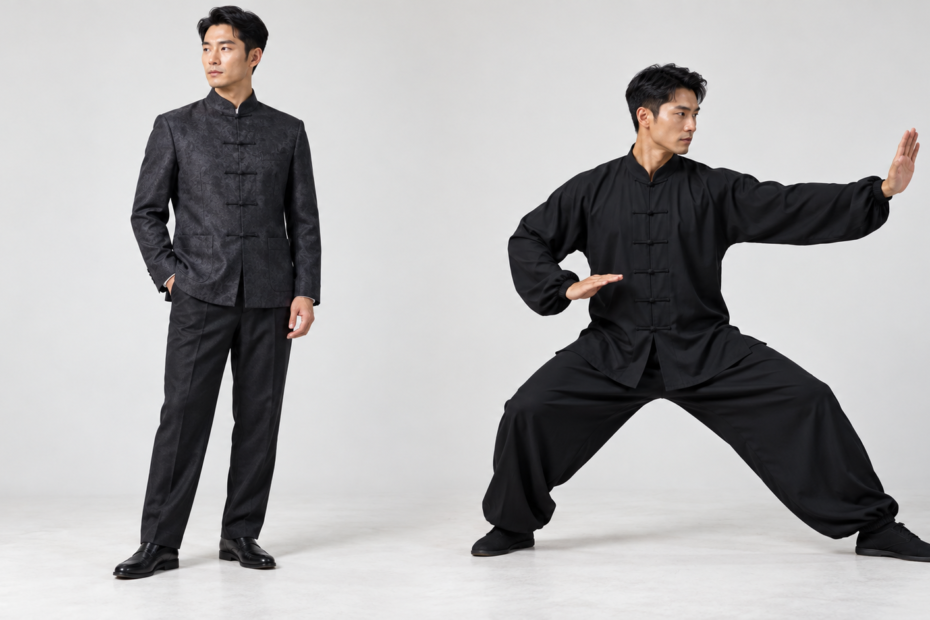
A Tang suit and a kung fu uniform can share a standing collar and frog closures, but they are chosen for different purposes. A Tang suit is primarily a Chinese-style jacket for social, cultural or formal wear. A kung fu uniform is a top-and-pants system selected to support martial arts training, demonstration or competition.
Retailers sometimes use the labels interchangeably, so the product name alone is not enough. Examine the cut, trousers, fabric, movement allowance and intended use.
What is the main difference?
The main difference is function. A Tang suit is judged largely by appearance, fit and suitability for an occasion. A martial arts uniform must also accommodate stances, kicks, arm extension and repeated movement.
A jacket can borrow details from both categories. The most reliable question is not “Which label is correct?” but “What activity was this garment designed to support?”
How does the jacket fit differ?
A social Tang suit may use a shaped torso, tailored shoulder and controlled sleeve width. That creates a polished outline for standing, dining and photography. A kung fu top often provides more room through the shoulder, upper back, elbow and side body so the wearer can extend and rotate without strain.
Loose does not automatically mean movement-ready. Raise both arms, reach forward, turn the torso and settle into the positions required by the practice. If the hem rides sharply upward or the closures pull apart, the cut may still be restrictive.
Why are pants important?
A Tang suit jacket may be sold alone and paired with tailored or straight-leg trousers. A kung fu uniform is more often conceived as a coordinated two-piece outfit. Its trousers may provide additional room through the seat, thigh and knee.
Competition needs can be more specific. Guidance published by Singapore’s ActiveSG notes that wushu attire must facilitate movement and keep techniques visible to judges, and that excessively wide pant legs can obstruct leg movements. Rules vary by organizer, so competitors should always check the regulations for their event.
How do fabrics differ?
Formal Tang suits may favor surface texture, embroidery or a firmer drape. Martial arts uniforms usually prioritize freedom of movement, durability, weight and moisture management. Reflective fabric may suit a demonstration but feel less practical for repeated training.
Fiber content cannot be confirmed from appearance. A shiny surface does not prove silk, and a matte surface does not prove cotton. Read the exact listing and care instructions. If the seller does not state the material, treat it as unknown.
Do frog buttons make a garment a kung fu uniform?
No. Frog closures are a visible design element used on many Chinese-style garments. Their presence does not establish that a top is suitable for martial arts. A movement garment also needs appropriate sleeve geometry, shoulder ease, body length and closure security.
For training, each loop and knot should stay secure through repeated motion. Decorative closures that are difficult to fasten or attached only lightly may be better for occasional social wear.
Which one works for a wedding or banquet?
A Tang suit is usually the clearer choice for a wedding, banquet or cultural dinner because it can be styled like a jacket with tailored trousers and formal shoes. Decoration can be selected to match the event, from tonal patterns to a strong red-and-gold statement.
A martial arts uniform may look too loose or activity-specific for a formal social setting. That said, terminology varies, and some retailers call polished Tang-style sets “kung fu suits.” Judge the actual garment rather than the marketing phrase.
Which one works for training?
Choose clothing approved by the instructor or school. Different martial arts schools use different dress codes, and competition organizers may specify cut, color, trim or logo placement. A casual Tang jacket should not be assumed safe or appropriate simply because it resembles uniforms seen in films.
Test range of motion, temperature comfort and closure security. For a first class, the school’s instructions matter more than purchasing a highly decorated set.
Buying checklist
- Define the use: social event, training, performance or competition.
- Check whether the listing includes pants or only a jacket.
- Compare actual chest, shoulder, sleeve and trouser measurements.
- Test the movements required by the activity.
- Verify fabric composition, care and closure construction.
- For competition, confirm the current organizer’s uniform rules.
For social and cultural styling, compare the dragon embroidery Tang suit and the bamboo leaf casual Tang suit shirt. Check exact garment details in the Panda-Tang shop, then use the Panda-Tang home page to review the current collection.
 Français
 English