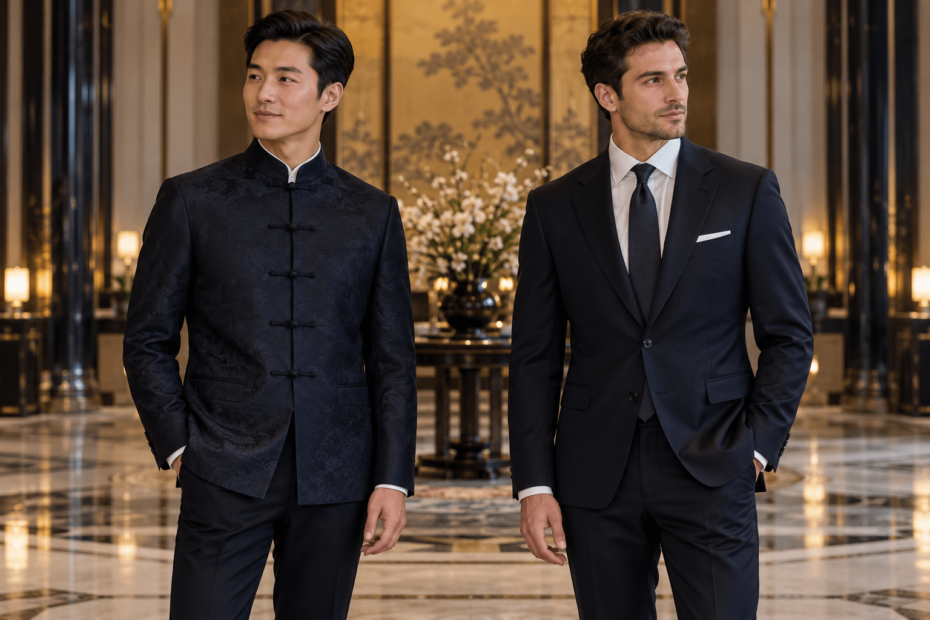
A Tang suit can be an appropriate formal choice for many weddings, banquets, and cultural occasions, while a Western suit remains the more predictable option for conventional business and explicitly Western dress codes. The invitation, host, venue, and role should decide before personal style.
Read the dress code first
Black tie, business formal, cocktail, festive, and cultural dress are not interchangeable. If an invitation names a tuxedo, dark business suit, or uniform requirement, ask the host before substituting a Tang suit.
When the event welcomes cultural formalwear, a structured Tang jacket with tailored trousers can be deliberate and polished. Never assume every organizer interprets dress codes the same way.
Weddings and family ceremonies
A Tang suit can connect naturally to a tea ceremony, banquet, or a wedding plan that includes Chinese-inspired clothing. Color and motifs should be coordinated with the couple and families.
A Western suit is easier to coordinate across a mixed wedding party and can transition between ceremony, photographs, and reception. The couple’s requested formality takes priority.
Business and institutional events
A dark Western suit is generally the safer choice for conservative corporate meetings, legal settings, diplomatic events, and venues with explicit business-formal conventions.
A Tang suit may be suitable for a cultural reception, gala, community leadership event, or host-approved formal dinner. When the context is uncertain, ask rather than treating cultural formalwear as universally accepted business attire.
Compare construction and silhouette
A Western suit uses lapels, a low front opening, shaped chest, and coordinated jacket and trousers. A Tang jacket commonly uses a standing collar, higher front, and frog closures, with straight or gently shaped proportions.
Both require controlled shoulders, a clean chest, appropriate sleeve length, and trousers that work with the chosen shoes. Good fit matters more than the category name.
Shirt, collar, and tie
The Western suit normally exposes a shirt collar and may require a tie. A Tang jacket’s standing collar and closures are usually the main neckline, so adding a conventional tie is unnecessary and can conflict with the design.
Choose a clean base layer that remains hidden or intentionally visible. Check that the collar closes comfortably and lies flat.
Fabric and surface
Worsted wool and similar suiting fabrics create a familiar matte business finish. Tang jackets may use brocade, jacquard, embroidery, plain woven fabric, or subtle texture, creating a wider range from restrained to celebratory.
Verify composition and care. A decorative surface does not automatically make a garment more formal, and a dense synthetic brocade may feel warm during a long indoor event.
Trousers and footwear
A matching Western suit offers a continuous fabric and color. A Tang jacket is often paired with separate black, navy, or charcoal tailored trousers; compare undertones and formality under event lighting.
Polished dark lace-up shoes are the safest formal option for either outfit. Simple loafers can work where the dress code is less strict.
Comfort and movement
Test sitting, reaching, walking, stairs, and greetings while fully dressed. A Tang jacket should not pull at its frog closures; a Western jacket should not collapse or strain across its button point.
Climate, lining, event length, and planned layers affect comfort. Try the outfit early enough to allow alteration.
Accessories and visual balance
A Western suit can use a restrained tie, pocket square, and boutonniere. A Tang suit often needs fewer accessories because the collar, closures, and fabric already provide detail.
Avoid adding unrelated motifs or cultural symbols for decoration alone. Confirm the meaning and suitability of any important element with the relevant family or organizer.
Rewear and wardrobe value
A conventional dark suit offers broad use across business, weddings, memorials, and formal dinners when styled appropriately. A restrained Tang suit can also be reworn, especially at cultural events and celebrations, while a bright patterned version may be more occasion-specific.
Buy for the real events in the wearer’s calendar, not an abstract versatility score.
Final decision checklist
- Confirm the invitation and ask the host when wording is unclear.
- Choose the garment category before selecting color or pattern.
- Compare finished measurements and allow time for alteration.
- Test the complete outfit with shoes and base layer.
- Photograph it under venue-like lighting.
- Verify care, delivery, and returns before the event.
Choose a Tang suit when the event welcomes Chinese-inspired formalwear and the garment is coordinated with its hosts. Choose a Western suit when the code is conventional business formal, explicitly Western, or uncertain and no clarification is available.
Compare a detailed dragon-embroidery Tang suit with a softer bamboo-leaf casual Tang shirt. Browse the Panda-Tang shop, then visit Panda-Tang to verify current measurements, materials, care, stock, returns, and delivery.
 Français
 English