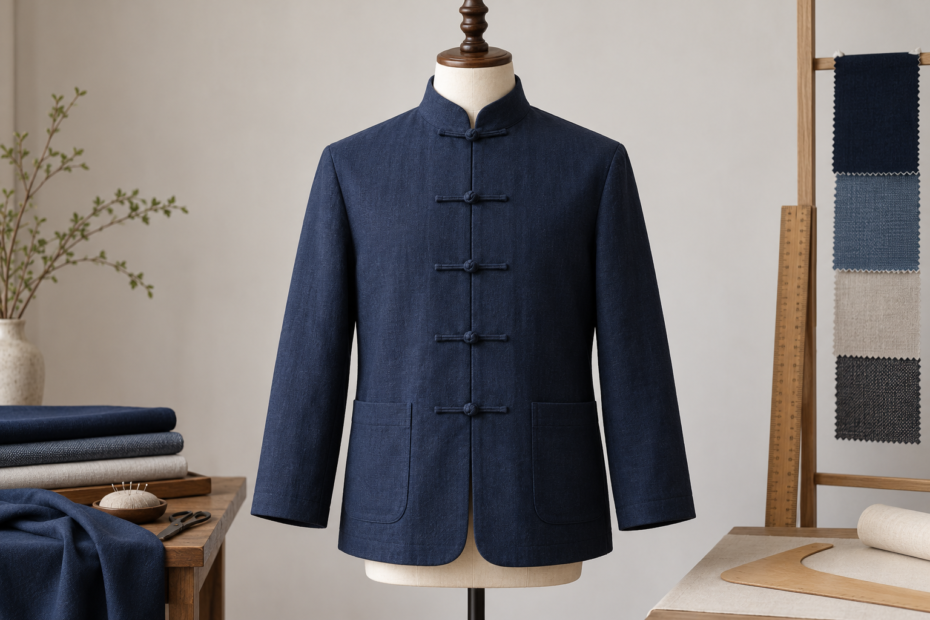
In contemporary retail, “Tang suit” commonly describes a Chinese-style jacket or shirt with a standing collar, a straight or slightly shaped body, and frog-style closures. The label covers many modern garments rather than one universally fixed historical pattern. To evaluate a piece responsibly, inspect its silhouette and construction, then ask what period, region, maker, or use the seller actually claims.
Why “authentic” needs a clear definition
Authentic can mean different things: made by a particular community, faithful to a dated historical pattern, appropriate to a living cultural practice, produced with specified traditional techniques, or simply a genuine product from the named seller. These meanings are not interchangeable.
Before judging authenticity, identify the claim. A modern Tang jacket can be well made and culturally respectful without being a museum reproduction. Conversely, a standing collar and frog closures alone do not prove an exact origin, period, or ceremonial role.
Look for a standing or Mandarin-style collar
Many modern Tang suits use a short upright collar that frames the neck without folding into lapels. Collar height, shape, stiffness, opening, and fastening vary. The collar should be centered, smooth, and comfortable when fastened.
A standing collar is a useful visual clue, not exclusive evidence. Similar collar forms appear across many garments, so consider it together with the front opening, closures, body shape, and documented context.
Examine the front opening
A common modern silhouette uses a center-front opening with evenly spaced decorative or functional closures. Some designs use an offset or asymmetrical opening, and shirt-style versions may be softer and less structured.
Check whether the front edges hang level and whether the pattern or trim aligns. Ask if hidden snaps, zippers, or buttons support the visible frogs. Construction should be described accurately rather than inferred from a front photograph.
Identify frog closures without treating them as proof
Frog closures are made from cord, fabric tubing, or related trim arranged into a button and loop. They can be functional, decorative, or combined with hidden fastening. Quality can be assessed through symmetry, secure attachment, loop size, and ease of use.
Frogs are strongly associated with the modern Tang suit look, but they also appear on other garments. Their presence does not establish a precise historical date, region, fiber, or method of manufacture.
Read the overall proportion
Modern Tang jackets are often straight or moderately shaped through the body, with long sleeves and a hem around the hip. Length, shoulder structure, vents, pockets, and side shaping vary by brand and intended use.
View the garment fastened from the front, side, and back. A coherent silhouette has balanced shoulders, level hems, aligned closures, and enough ease for sitting and reaching. A size label cannot replace finished-garment measurements.
Distinguish a jacket, shirt, set, and costume
A lined structured jacket, an unlined casual shirt, a coordinated jacket-and-trouser set, and a theatrical costume may all be marketed with similar words. Identify what is included, how the item is constructed, and what use it is designed to support.
Costume is not automatically a criticism; stage garments have their own requirements. Problems arise when a seller presents a lightweight decorative piece as tailored formalwear or makes unsupported historical claims.
Inspect fabric and decoration separately
Brocade, satin-like surfaces, jacquard patterns, embroidery, piping, and solid matte fabrics can all appear in modern Tang suits. No single fiber or motif defines the entire category. Ask for verified shell and lining composition, decoration method, weight, care, and close photographs.
Do not assume that sheen means silk, that embroidery is handmade, or that a motif has one universal meaning. Those claims require specific evidence.
Check workmanship
Useful quality indicators include balanced shoulders, smooth collar construction, secure frogs, consistent seam allowances, clean lining, reinforced stress points, aligned motifs, functional pockets, and appropriate pressing. These details evaluate the garment itself, not its cultural authenticity.
Turn the garment inside out when possible and compare it with the seller’s specification. Fit and workmanship should remain separate from claims about tradition or origin.
Ask for provenance when a historical claim matters
If the seller describes a garment as a reproduction, heritage piece, region-specific style, or handmade traditional work, request the evidence behind that description. Useful documentation may identify the maker, design source, materials, techniques, date, region, or institution involved.
Generic phrases such as “ancient,” “imperial,” or “traditional Chinese” are too broad to verify a precise claim. A responsible description should state its scope and limitations.
Evaluate the garment in cultural context
China contains many regional, ethnic, historical, and contemporary dress traditions. “Chinese clothing” is not one uniform silhouette. Avoid using a modern retail Tang suit as a substitute for every form of Chinese dress or as proof of a single uninterrupted design history.
For ceremonies or community events, ask organizers or family members what clothing is appropriate. Context can matter more than a retailer’s category label.
A practical identification checklist
- Short upright collar, described accurately.
- Center or documented asymmetrical front opening.
- Functional or decorative frog-style closures.
- Balanced jacket or shirt proportions.
- Verified shell, lining, decoration, and care information.
- Clear distinction between modern fashion, performance wear, and historical reproduction.
- Evidence for any specific origin, technique, or authenticity claim.
- Finished measurements and real-use fit testing.
How to compare modern examples
Review the visible construction of a dragon-embroidery Tang suit and the softer presentation of a bamboo-leaf casual Tang shirt. These examples show variation within current retail use; they should not be treated as a complete history of Chinese dress.
Browse the Panda-Tang shop to compare current silhouettes, then visit Panda-Tang to confirm product descriptions, measurements, materials, care, stock, returns, and delivery.
 Français
 English