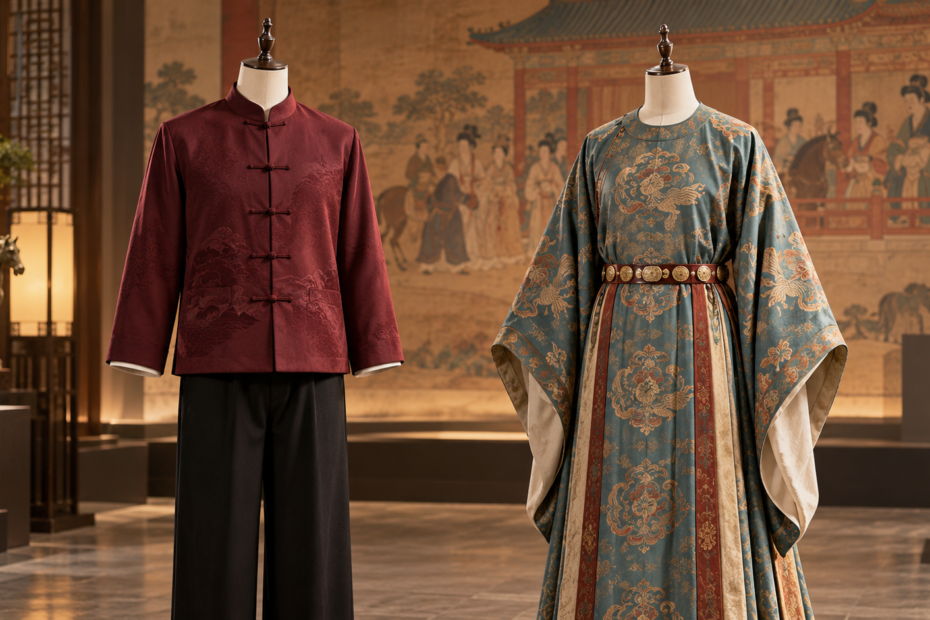
No: the modern garment sold in English as a “Tang suit” should not automatically be treated as the standard clothing of China’s Tang dynasty. The shared word “Tang” creates an easy but misleading shortcut. Tang-dynasty dress covered many garments, wearers, regions, and foreign influences, while today’s Tang-style jacket is a modern retail category usually recognized by a standing collar, straight body, and frog closures.
That does not make the modern garment inauthentic or unworthy. It means buyers should distinguish a contemporary expression of Chinese style from a documented reconstruction of clothing worn between 618 and 907.
Why the name causes confusion
“Tang” can refer to the historical dynasty, but it also carries a broader cultural association in later language and overseas Chinese contexts. Retail labels often prioritize recognition over precise costume history. When an online listing moves from “Tang-style” to “worn by Tang emperors” without sources, the wording has crossed from category naming into a claim that needs proof.
Judge the exact sentence. “Inspired by Chinese tradition” is not the same as “an exact Tang-dynasty design.” A reproduction should identify the source object, tomb figure, mural, painting, archaeological report, or scholarly reconstruction on which its cut is based.
What official sources show about Tang-dynasty dress
The Metropolitan Museum of Art describes Tang China as highly international, with Central Asian and Persian influences visible in clothing. Its overview notes close-fitting sleeves, short tunics, high boots, and fashions connected with exchange along trade and diplomatic routes. The Hong Kong Museum of History’s educational material describes a futou headscarf and round-collared, narrow-sleeved robe for officials, with the general male population also imitating this style.
These sources do not reduce an entire dynasty to one uniform. They show why a generic modern jacket cannot stand in for every Tang-period garment. Gender, rank, activity, court rules, and changing fashion all mattered.
Compare the silhouettes first
| Feature | Modern Tang-style jacket | Evidence often seen for Tang-period menswear |
|---|---|---|
| Length | Often waist or hip length | Frequently represented as tunics or robes, with variation |
| Collar | Often a short standing collar | Round-collared robes are documented in museum education |
| Closure | Frog or knotted closures commonly define the retail look | Must be checked against the specific dated object or image |
| Styling | Usually paired with modern trousers | Period ensembles could include robes, belts, boots, headwear, and layered pieces |
| Purpose | Celebration, casual cultural wear, performance, or contemporary fashion | Varied by office, social rank, activity, gender, and occasion |
The comparison is deliberately cautious. Historical evidence is diverse, and modern garments vary. The conclusion is not that no feature has older precedents; it is that a name and a few details do not establish a direct, unchanged lineage.
Claims that require stronger evidence
- “Exact Tang-dynasty replica”: ask for the source object or image, date, and reconstruction method.
- “Worn by every man in the Tang dynasty”: question any claim that ignores rank, region, occupation, and fashion change.
- “Imperial dragon design”: ask which period, claw count, emblem system, and garment regulation are meant.
- “Ancient handmade technique”: request the actual production steps and clarify machine versus hand work.
- “Traditional silk”: verify the fiber label separately from the historical narrative.
Do not substitute Qing evidence for Tang evidence
Many surviving and well-documented Chinese court garments belong to the Qing dynasty, 1644–1911. The Met and the V&A hold and discuss Qing robes with detailed regulations, motifs, and status meanings. Those sources are valuable, but a Qing court robe cannot prove what people wore roughly a millennium earlier during the Tang.
Watch for listings that combine a Tang-dynasty date, Qing-style court imagery, and a modern frog-closure jacket as if all belonged to one unchanged outfit. Each visual source should be dated and explained.
Separate motif history from garment history
Dragons, clouds, botanical designs, and geometric borders can appear across media and periods. A motif may have a long cultural history even when the jacket shape is modern. Conversely, a historically plausible silhouette can carry a newly created surface pattern. Sellers should describe both layers rather than letting one imply the other.
For example, compare the visual emphasis of a dragon-embroidery Tang suit with a subtler bamboo-leaf Tang shirt. These are modern product choices; the motif alone does not date the entire garment.
How to assess a seller’s explanation
- Ask what the seller means by “Tang suit.”
- Request a source for any dynasty-specific sentence.
- Check museum records for the claimed collar, sleeve, length, and closure.
- Confirm whether images show an original object, replica, illustration, or modern styling.
- Look for qualifiers such as “modern interpretation” or “inspired by.”
- Verify materials, construction, and sizing independently.
A responsible seller can say “we do not know” or narrow a claim after checking. Precision is more credible than a dramatic story that collapses centuries of dress history.
What should matter at purchase time
If you want a wearable modern Tang suit, prioritize accurate garment measurements, comfort, fabric composition, closure quality, care instructions, return terms, and event suitability. If you need Tang-dynasty costume for research, education, theatre, or reenactment, use a specialist maker and provide a documented visual reference rather than relying on a generic retail category.
Explore the Panda-Tang collection as contemporary Chinese menswear, and visit Panda-Tang to check current information before ordering. The most honest purchase is one where the garment’s present-day qualities stand on their own and its historical inspiration is described with appropriate limits.
 English
 Français