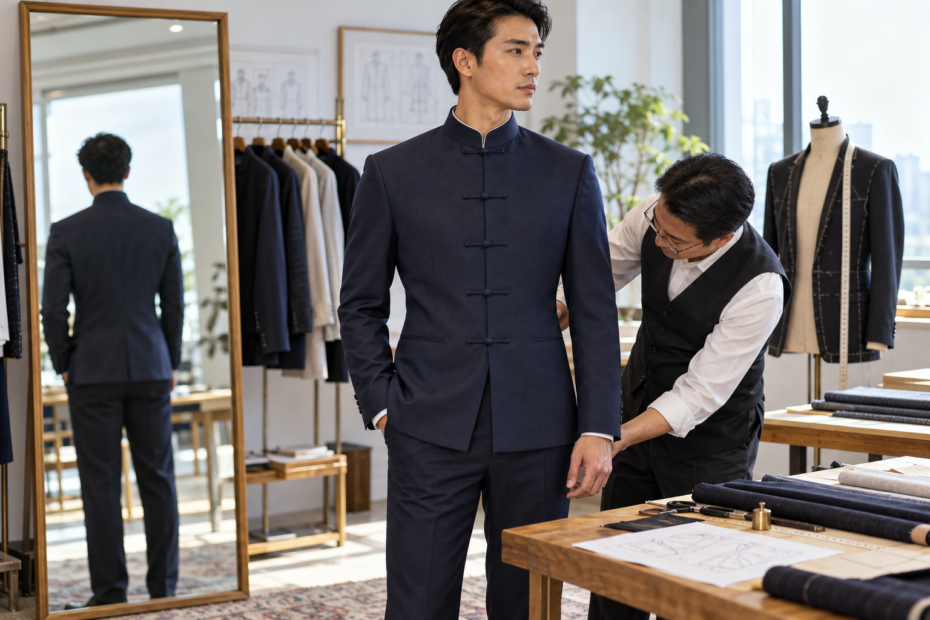
Modern tailoring changes a Tang suit silhouette by refining the shoulder line, shaping the waist, adjusting jacket length, and coordinating sleeve, collar, and trouser proportions. The standing collar and frog closures may remain recognizable, but a closer fit, lighter structure, and cleaner hem can make the garment work more naturally with contemporary menswear.
The shoulder sets the modern outline
A traditional-looking straight jacket can have a soft shoulder, while a modern formal version may use light structure to create a clearer line. The important issue is not padding alone but where the shoulder seam sits and how the sleeve hangs from it.
A seam placed too far outward can make the jacket look oversized; one placed too far inward can pull across the upper back. Check the shoulder from front and back, then reach forward to confirm that the structure does not prevent ordinary movement.
Waist shaping changes the visual balance
Many contemporary jackets introduce gentle suppression through the side seams or pattern pieces. This can create a cleaner transition from chest to hem without making the garment tight. Excessive shaping, however, may pull the frog closures apart or cause the front edges to flare.
Fasten every closure and view the jacket from the side. The waist should look intentional while leaving enough room for breathing, sitting, and a base layer.
Jacket length affects formality
A shorter hem can feel contemporary and pair easily with tailored trousers, while a longer hem creates more coverage and a stronger vertical line. Length must work with the wearer’s torso and trouser rise rather than follow one universal rule.
Sit in the jacket and check whether the hem bunches across the lap or rises above the waistband. Pockets, vents, and motifs should remain well positioned instead of looking displaced by an unsuitable length.
Higher armholes can improve movement
A well-shaped armhole that sits close to the body can let the sleeve move with the arm. An excessively low armhole may lift the whole jacket when the wearer raises a hand. Modern tailoring often refines this relationship to reduce unnecessary fabric.
Test driving, dining, reaching, and crossing the arms. Mobility depends on the complete pattern, so a smaller-looking armhole is not automatically better.
Sleeve pitch creates a cleaner stance
Sleeve pitch is the angle at which the sleeve is set. A modern jacket may be cut for a natural forward arm position, reducing diagonal twists when the wearer stands or uses a phone. Upper-arm width and sleeve taper also affect the visual line.
Check sleeve length while the arms are relaxed and moving. Decorative cuffs or piping can limit alterations, so verify construction before buying with tailoring in mind.
The collar can be crisp without being rigid
A contemporary standing collar often uses controlled interfacing to maintain shape while avoiding excessive thickness. Collar height and circumference should suit the wearer’s neck, posture, and intended base layer.
Fasten the top closure, turn the head, look down, and sit. A collar that presses the throat or lifts away from the back neck will not become comfortable simply because the jacket looks sharp in a photograph.
Closures influence the front line
Frog closures can be spaced and scaled to reinforce a clean vertical rhythm. Some modern jackets pair decorative frogs with hidden support, while others rely on the frogs as the functional fastening. Buyers should verify the actual design.
The front should remain level and smooth without closures carrying constant strain. If the gaps between frogs open widely, the fit or balance needs review.
Vents and pockets add function
Side vents can provide room around the hips and make sitting easier. Streamlined welt pockets create a formal surface, while patch pockets make a jacket more casual. Pocket position also changes how long or wide the body appears.
Place normal items in the pockets during fitting. A phone or wallet should not pull the jacket out of alignment or create uncomfortable pressure when seated.
Fabric determines whether the cut holds
A structured fabric can support a defined shoulder and collar, while a softer cloth follows the body and creates a relaxed silhouette. Lining affects friction, warmth, and how the jacket slides over a shirt. Stretch can add comfort but cannot correct a poorly balanced pattern.
Confirm fiber composition, weight, lining, surface texture, and care from the seller. Do not infer these properties from sheen or product photography.
Modern trousers complete the proportion
Straight or gently tapered trousers usually support a contemporary Tang jacket without creating a top-heavy silhouette. The rise should keep the waistband covered, and the hem should work with the final shoes.
A matching set needs consistent color and texture. When pieces come from different sources, a deliberate contrast such as black or charcoal can look more coherent than an imperfect near-match.
Use a full-body fitting process
- Wear the intended base layer and trousers.
- Fasten the collar and all closures.
- Check front, side, and back alignment.
- Sit, walk, reach, and use stairs.
- Photograph the outfit in daylight and indoor light.
- Prioritize shoulder, chest, and balance before cosmetic alterations.
Compare the stronger visual detail of a dragon-embroidery Tang suit with the quieter silhouette of a bamboo-leaf casual Tang shirt. Browse the Panda-Tang shop, then visit Panda-Tang to confirm current measurements, materials, care, stock, returns, and delivery.
 English
 Français