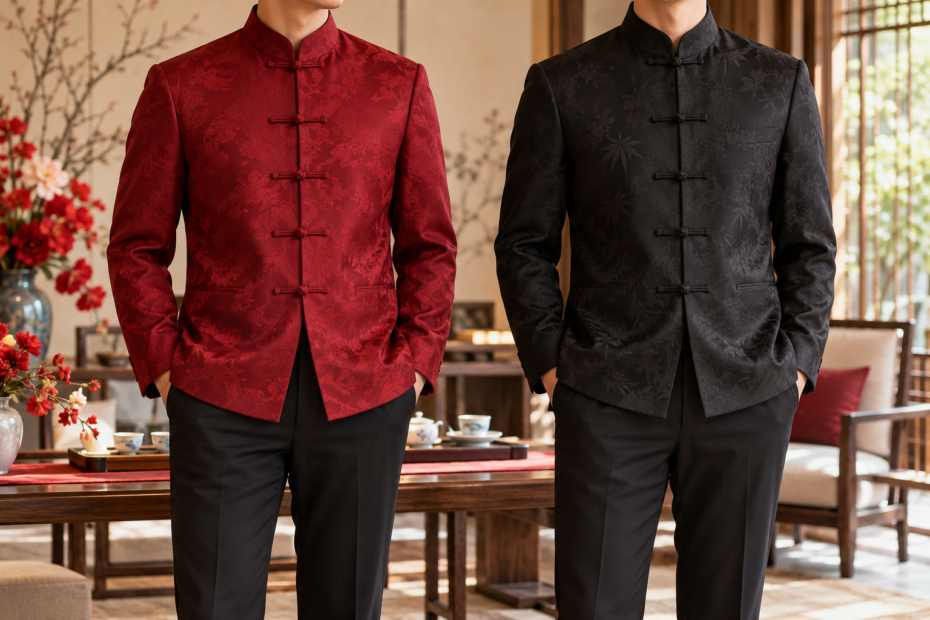
Red creates a more visible celebratory statement for a wedding tea ceremony, while black offers a restrained formal look and easier rewear. Neither color is universally correct. The couple should decide with their families based on the specific ceremony, cultural background, wedding palette, venue, photography, and personal comfort.
Ask the family before applying a general rule
Wedding tea ceremonies differ across regions, communities, and individual families. Some couples prefer red or burgundy for the groom, while others coordinate black, navy, gold, or a suit with the partner’s clothing.
Confirm expectations with the people involved in the ceremony. Online claims about one mandatory color should not replace family guidance.
What red communicates visually
A red or burgundy Tang suit stands out clearly in photographs and creates an immediately festive appearance. It can coordinate with red floral decor, table settings, or a partner’s outfit without needing many accessories.
The exact shade matters. Deep burgundy is usually more subdued than bright red, while metallic brocade can intensify either color under flash.
What black communicates visually
A black Tang suit feels formal, controlled, and versatile. Frog closures, texture, and subtle patterns remain visible without adding another strong color. Black also transitions easily into a reception or future formal event.
Against a dark background, however, a black jacket can lose detail. Lighting, fabric texture, and contrast with trousers or a base layer help preserve the silhouette.
Compare the ceremony setting
Red often suits a warm, decorated indoor tea room or a ceremony designed around a celebratory palette. Black can work in a minimalist venue, mixed Western-Chinese wedding schedule, or an event where the couple wants the partner’s attire to carry more color.
View the outfit in the actual room when possible. Wall color, wood, flowers, and lighting can change how both options photograph.
Coordinate with the partner
The outfits do not need to match exactly. They can connect through one repeated color, fabric sheen, motif scale, or level of formality. A red jacket can echo a small detail in the partner’s clothing; a black jacket can provide contrast.
Avoid adding symbols or motifs solely because they are assumed to have universal meaning. Confirm any important cultural interpretation with the family or a reliable source.
Compare formality and fabric
A structured black brocade can appear more formal than a casual red cotton shirt. Color alone does not determine dress level. Jacket structure, lining, surface, embroidery, trousers, and shoes all contribute.
Verify fiber composition, weight, lining, and care. Dense fabric may feel warm during a long indoor ceremony.
Choose trousers and shoes
Black tailored trousers work with both red and black jackets. With a black jacket, charcoal trousers can create subtle separation; with a red jacket, black keeps the focus above the waist. Polished black shoes are the simplest formal choice.
Set trouser length with the final shoes and test kneeling, sitting, standing, and walking if the ceremony sequence includes those movements.
Keep accessories restrained
A red jacket usually needs very little additional color. A black jacket can accept one controlled accent, such as a pocket square or boutonniere, if it aligns with the couple’s plan. The standing collar and frog closures generally replace the need for a necktie.
Ensure flowers, pins, or jewelry do not damage brocade or catch on closures.
Consider photography
Red attracts attention and may appear brighter under warm light or flash. Black can show lint and lose texture in shadow. Photograph both samples or outfits in daylight, indoor light, and flash before choosing.
Ask the photographer how the venue and partner’s outfit will be lit, but keep the final decision personal and culturally appropriate.
Consider rewear value
Black is often easier to use again at dinners, cultural programs, and formal events. Deep burgundy can also be versatile, while bright red may remain primarily celebratory. Rewear matters only after the ceremony requirements and personal preference are satisfied.
A garment that fits well and feels authentic to the wearer will usually be used more than one chosen only for a presumed rule.
Complete a ceremony rehearsal
- Wear the full outfit, including shoes.
- Practice entering, greeting, serving tea, sitting, and standing.
- Check collar and midsection comfort.
- Confirm sleeves do not approach cups or trays.
- Photograph the outfit beside the partner’s clothing and decor.
- Verify care and transport plans before the wedding day.
Decision summary
Choose red when the couple and family want a visible celebratory garment that connects to the event palette. Choose black when they prefer restrained formality, tonal styling, or greater rewear flexibility. Use burgundy, navy, or another approved option when it better fits the family and wedding design.
Compare the visual impact of a dragon-embroidery Tang suit with a quieter bamboo-leaf casual Tang shirt. Browse the Panda-Tang shop, then visit Panda-Tang to verify current measurements, materials, care, stock, returns, and delivery before the ceremony.
 English
 Français