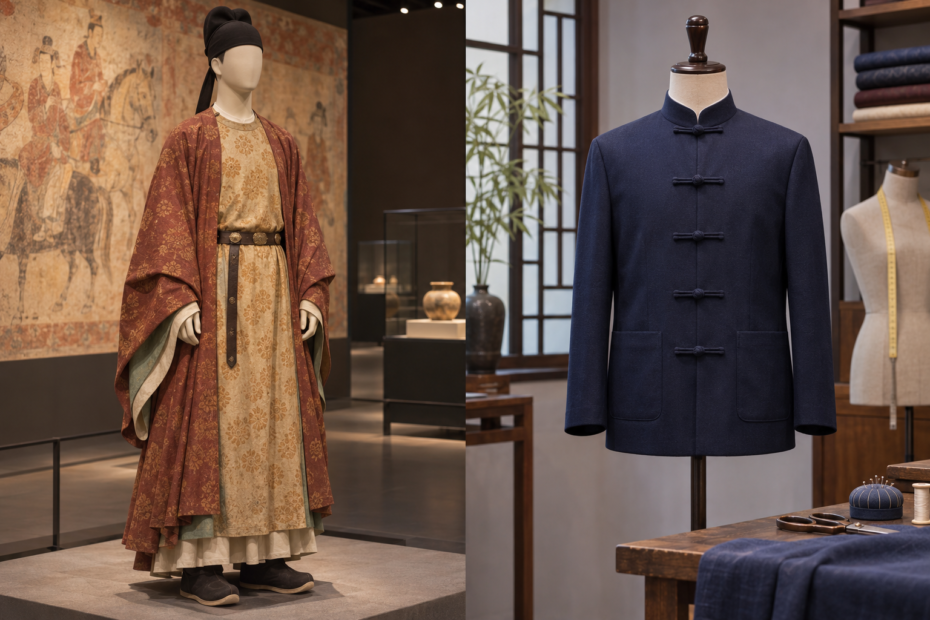
The modern Tang suit, or tangzhuang, is not simply the clothing worn during the Tang dynasty. Tang-period dress must be studied through defined dates, places, wearers, surviving objects, images, texts, and scholarly interpretation, while the modern Tang suit is a contemporary jacket category designed for present-day sizing, production, and occasions.
Begin with chronology and evidence
Tang dynasty clothing belongs to a specific historical period and varied across decades, regions, communities, status groups, activities, and contacts with other cultures. A single robe, figurine, mural, or modern illustration cannot represent every wearer.
Reliable study compares museum objects, excavated textiles, tomb figures, paintings, written descriptions, technical analysis, and current scholarship. Each source has limits, so responsible reconstruction labels uncertainty instead of filling gaps with attractive assumptions.
Why the modern name is misleading
In current retail language, Tang suit often means a standing-collar jacket with frog closures worn over trousers. The English name can imply Tang-dynasty origin even though the modern category draws on later Chinese dress, twentieth-century styling, contemporary tailoring, and global fashion.
A product title is marketing metadata, not a provenance record. Ask what the seller can verify about the actual pattern, materials, manufacture, and intended occasion rather than treating the word Tang as proof of an ancient design.
Compare the overall silhouette
Historically grounded Tang-period ensembles can include different robes, skirts, trousers, belts, layers, sleeve forms, headwear, and footwear depending on the defined context. Their proportions and wearing systems should follow evidence for that target.
A modern Tang suit usually creates a compact jacket-and-trouser outline familiar to contemporary menswear. It often uses a hip-length body, standing collar, shaped shoulder, convenient pockets, and a front closure arranged for modern movement and photography.
Compare pattern cutting and fit
Historical reconstruction may use garment widths, straight or shaped panels, overlaps, gussets, sleeve structures, ties, and layering methods unlike a fitted modern jacket. Fit should be judged according to the source tradition, not by current suit-jacket expectations.
Modern Tang jackets are commonly graded into retail sizes and may use set-in sleeves, facings, interlining, lining, and shaped seams. These choices can improve present-day consistency, but they do not demonstrate Tang-period construction.
Closures need separate verification
The fastening method of a historical garment must be supported for its date and context. Similar-looking ties, loops, buttons, belts, and wrapped fronts can serve different functions across garments and periods.
Frog closures are a recognizable feature of many modern Tang suits. They may be functional, decorative, or backed by hidden snaps, and their size and spacing may be chosen for balance and ease rather than historical reconstruction.
Materials and production tell different stories
A research-led reconstruction considers fiber, weave, dye, thread, fabric width, embroidery method, finishing, and the limitations of historical tools. Modern substitutions should be disclosed when the original material is unavailable or unsuitable.
A contemporary Tang suit may legitimately use synthetic blends, machine embroidery, modern dyes, fusible interlining, industrial sewing, and standardized trims. Buyers should judge whether those facts suit comfort, care, budget, and occasion rather than confusing them with archaeological evidence.
Choose according to the event
A museum demonstration, reenactment, academic project, or historically specified production may require a named period, documented sources, and a complete wearing system. A generic Tang suit should not be substituted unless the organizer approves it.
A wedding, banquet, cultural celebration, or modern performance may welcome a Tang suit precisely because it is recognizable and easy to coordinate. Honest contemporary clothing can be culturally meaningful without claiming to reproduce dynasty dress.
Use precise labels
Reserve historically reconstructed for work with a stated target and documented method. Historically inspired is clearer when a designer adapts selected evidence into a modern shape.
Use modern Tang suit or contemporary tangzhuang for present-day jackets sold in this category. Clear language helps customers select the right clothing and protects historical research from being reduced to a vague visual theme.
Turn the invitation into a clothing brief
Before comparing Tang dynasty clothing research with modern Tang suit design, write down the event type, venue, season, start and finish times, indoor and outdoor segments, expected photographs, and the wearer’s role. A groom, host, speaker, parent, attendant, and ordinary guest may attend the same event but need different levels of visibility and formality.
Record any wording from the invitation instead of translating it into a preferred garment too quickly. Black tie, business formal, cultural dress, festive, historical dress, and smart casual describe different expectations. When the wording is broad, the host or organizer is a better source than a generalized online rule.
Separate garment category from product quality
Neither Tang dynasty clothing research nor modern Tang suit design is automatically formal, comfortable, accurate, or well made. A category name describes a family of garments; the individual product determines fabric, pattern cutting, lining, construction, closures, finishing, and fit. Compare the actual items rather than idealized versions of each category.
Ask for clear front, side, back, interior, collar, closure, cuff, hem, and pocket photographs. Verify what is included, because styling images may show trousers, shirts, belts, shoes, jewelry, or accessories sold separately. A good comparison uses equivalent information for both choices.
Measure the wearer and a garment that fits
Body height and weight are only context. Record neck, shoulder, chest, midsection, hip, sleeve, preferred jacket or garment length, and any posture or proportion that affects fit. Use the seller’s measurement method and keep the original units to reduce conversion and rounding errors.
Measure a comfortable garment laid flat and photograph the tape position. Confirm whether a chart shows body measurements, finished-garment circumference, or flat width. If the wearer falls across sizes, identify the controlling measurement and ask whether alteration is realistic before simply choosing the largest size.
Evaluate fit through movement
A static front photograph cannot prove event-ready fit. Fasten the garment as intended, then sit, stand, walk, climb stairs, reach forward, turn, greet people, and use any ceremony posture the schedule requires. The collar should not press the throat, the shoulders should remain controlled, and closures should lie without strain.
Test the complete base layer and planned trousers or lower garment. Fabric that feels comfortable for five minutes may restrict breathing, dining, driving, or dancing over several hours. Hem, sleeve, slit, and pocket positions also need to work while moving, not only while posing.
Compare fabric with evidence
Do not identify silk, cotton, linen, wool, brocade, hand embroidery, or natural dye from a photograph. Request the stated fiber composition, lining details, fabric weight or seasonal guidance when available, stretch information, care instructions, and close views of the surface.
Sheen and texture affect formality and photography as much as color. Dense woven patterns and metallic threads can become brighter under flash; matte fabrics may look quieter but reveal lint or creasing. If swatches are available, view them in daylight and the venue’s likely artificial light.
Build a complete outfit rather than choosing one garment
List every visible component: base layer, trousers or robe layers, socks, shoes, belt, jewelry, boutonniere, bag, and outerwear. Each component should support the same level of formality. Adding several unrelated motifs or finishes can make a carefully chosen main garment look accidental.
Try the final shoes before hemming. Check what appears when the wearer sits, whether socks connect trousers and footwear, and whether an outer coat crushes the collar or decoration. Photograph front, side, and back views at conversational distance and full-body distance.
Coordinate without creating a uniform
Couples and groups do not need identical fabric or color. Coordination can come from one repeated hue, similar formality, compatible surface texture, or a shared degree of visual detail. Exact matching can look forced and may be impossible across different materials.
Place garments beside one another before deciding. A small swatch is useful, but a full outfit reveals how much visual space each color occupies. Let the people whose role is central to the event carry the strongest color, motif, or silhouette unless the group has agreed otherwise.
Use color carefully
Color meanings and wedding customs vary among families, regions, communities, and personal traditions. Do not describe one shade as universally required, forbidden, lucky, masculine, or historically correct. Ask the people organizing the event whenever color has ceremonial importance.
Screen settings and edited product photography are unreliable for exact matching. Request unfiltered daylight images or samples when the palette matters. Deep navy may photograph almost black, black can lose texture in shadow, and red or metallic surfaces can become more intense under warm light.
Plan for climate and duration
Consider travel, waiting, photography, meals, speeches, outdoor transitions, dancing, and the return journey. A dense lined garment may be comfortable in a cool room but tiring outdoors or under stage lighting. A light garment may need discreet thermal layering in cold weather.
Check ventilation, lining, sleeve width, and the ease needed over the intended base layer. Arrange a secure place for outerwear and a method for transporting the garment without crushing it. Comfort supports posture and confidence throughout a long formal event.
Understand alteration boundaries
Shoulders, collars, closure placement, embroidered panels, woven motifs, pocket positions, and long hems can be difficult or expensive to alter. A tailor needs to inspect the actual garment, seam allowance, lining, and decoration before promising a result.
Order early enough for fitting and one corrective round. Do not remove tags or commission alterations until the return policy is understood. If decoration crosses a seam or hem, ask how shortening or narrowing would change the design.
Review care before purchase
A formal garment is not practical if its required care, storage, or pressing cannot be arranged before and after the event. Read the sewn-in care label, ask how wrinkles should be removed, and identify a qualified cleaner when the item is structured, lined, or decorated.
Plan storage on a suitable hanger or in a supported fold, depending on weight and construction. Protect frog closures, embroidery, and delicate surfaces from pressure and snagging. Never assume that garments in the same category share the same cleaning method.
Check cultural and historical claims
Use accurate, limited descriptions. Contemporary Chinese-inspired formalwear, historical reconstruction, ceremonial clothing, and stage costume are not interchangeable categories. A retail title does not by itself establish dynasty, region, authenticity, symbolism, or traditional status.
When accuracy matters, consult museum collections, academic dress history, qualified practitioners, or event specialists and document which period or community is being discussed. When accuracy is not required, describe observable features without inventing lineage or meaning.
Make the final decision with a scorecard
Score Tang dynasty clothing research and modern Tang suit design separately for dress-code fit, role fit, movement, climate, coordination, tailoring risk, care, delivery certainty, return terms, and realistic rewear. Weight the first six criteria more heavily than novelty or imagined versatility.
A scorecard does not replace personal preference, but it exposes tradeoffs. If both choices remain close, select the one the wearer can test properly, receive on time, and wear with confidence. If either option conflicts with the host’s instructions, remove it from consideration.
Complete a full rehearsal
At least several days before the event, wear every component together for long enough to reveal pressure, slipping, heat, and movement problems. Practice entrances, greetings, photographs, dining, stairs, and any ceremony actions. Ask a trusted observer to check the back and side views.
Prepare a small care plan with a lint brush if approved, a clean cloth for immediate blotting, spare appropriate fasteners only when supplied, and contact details for the tailor or cleaner. Do not use tape, pins, chemicals, or heat on the event day without garment-specific approval.
Verify the order before payment
Save the exact product page, selected color, size, customization notes, promised dispatch window, shipping method, taxes or duties guidance, and return conditions. Ask the seller to confirm any important point in writing, especially when the event date leaves little room for exchange. Screenshots help resolve later differences between a listing and the delivered item.
When the parcel arrives, record the unboxing, inspect the garment in clean light, and compare it with the order before removing tags. Check measurements, color, closures, seams, lining, decoration, odor, stains, and included pieces. Contact the seller promptly if something differs; do not alter, wash, press, or wear the item until the remedy and return eligibility are clear.
Final choice
Choose evidence-based reconstruction when the purpose requires Tang-period accuracy and a defined historical target. Choose a modern Tang suit when present-day fit, convenience, and Chinese-inspired styling are the priorities, and describe the garment honestly as contemporary design.
Compare a detailed dragon-embroidery Tang suit with a softer bamboo-leaf casual Tang shirt. Browse the Panda-Tang shop, then visit Panda-Tang to verify current measurements, materials, care, stock, returns, and delivery.
 English
 Français