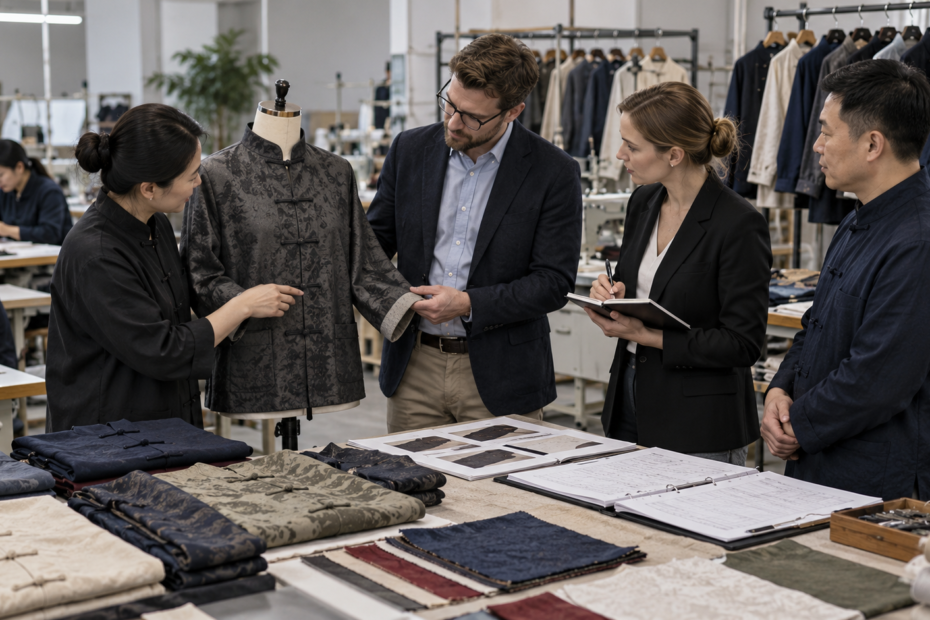
Tang suit supplier due diligence should establish who will make the garments, whether that operation can meet the specification, and how quality, payment, and delivery risks will be controlled. A polished website or low quotation is not proof of production capability. Buyers should collect evidence, compare it with the proposed order, and start with a controlled sample or trial order.
Verify the business identity
Request the supplier’s registered legal name, business address, registration details, invoicing entity, bank beneficiary, and primary contacts. Check that names and locations are consistent across quotations, contracts, invoices, and payment instructions. Independently verify corporate and tax information through relevant official or qualified local sources.
A different beneficiary, last-minute account change, or reluctance to identify the contracting entity requires explanation before payment. Legal and compliance requirements vary by country, so use qualified advisers for decisions that exceed routine commercial checks.
Confirm the supplier’s actual role
Ask whether the company is the manufacturer, a trading company, an agent, or a combination. None of these models is automatically unsuitable, but the answer affects visibility, pricing, accountability, and change control. If production is subcontracted, identify the factory responsible for cutting, sewing, embroidery, finishing, and packing.
Request a live video walkthrough or independent factory audit when order value or risk justifies it. Look for equipment, current production, material storage, quality stations, worker safety practices, and records that relate to the claimed capability.
Match capability to the proposed Tang suit
Review experience with standing collars, frog closures, lined jackets, brocade, embroidery, piping, size grading, and coordinated trousers. General garment experience does not prove control of decorative alignment or closures that carry repeated tension.
Ask for recent examples with comparable materials and construction, while respecting other customers’ confidentiality. Confirm monthly capacity, minimum quantities, peak-season loading, key subcontractors, and how the supplier handles rush orders or material shortages.
Use a documented sample process
Issue a dated specification covering fabric, lining, color, collar, closures, pockets, decoration, labels, packaging, finished measurements, and tolerances. State what the sample is intended to approve: appearance, fit, material, workmanship, packaging, or all of them.
Measure and inspect the sample rather than approving it from photographs alone. Record changes in writing and identify the final approved version. If the sample uses substitute fabric or decoration, it cannot validate those bulk-production details.
Assess size and specification control
Confirm whether the size chart contains body measurements or finished-garment measurements. Require consistent points of measure, grading rules, and tolerances. Review the smallest, middle, and largest sizes when scaling risk is material.
Ask how patterns, markers, and revisions are controlled. A useful supplier should be able to identify the current specification and explain how production staff avoid using an obsolete file.
Review the quality system
Ask for incoming-material checks, in-line controls, final inspection records, needle or sharp-object controls where relevant, shade management, and defect handling. Agree how major and minor defects will be defined for the order and whether an independent inspection is permitted.
Quality claims should lead to observable records. Request anonymized examples of inspection reports or corrective actions, then confirm the process in the purchase agreement.
Check commercial terms carefully
- Unit price and exactly what it includes.
- MOQ by style, color, size, or total order.
- Sample, setup, artwork, label, and packaging charges.
- Payment stages, currency, beneficiary, and refund conditions.
- Production lead time and what starts the clock.
- Incoterm, named place, freight scope, and insurance responsibility.
- Remedies for delay, shortage, defects, or specification deviation.
Evaluate communication and traceability
Send a structured request and see whether the response answers each point. Accurate acknowledgements, version numbers, realistic timelines, and early disclosure of limitations are stronger signals than instant agreement. Keep approvals, changes, and payment instructions in a durable written record.
References can add context, but verify that they relate to similar order size, product complexity, and recent performance. Do not rely on testimonials controlled solely by the supplier.
Start with a controlled trial order
Use a quantity large enough to test repeatable production but small enough to limit exposure. Approve a pre-production sample, define inspection timing, retain a control sample, and verify packaging before shipment. Review measurement results, defects, communication, documentation, and delivery after receipt.
Common warning signs
- Inconsistent company or bank details.
- Pressure for rapid full payment without documentation.
- Refusal to provide a sample or permit reasonable inspection.
- Unexplained changes in factory, fabric, or specification.
- Quotations that omit major cost or delivery assumptions.
- Promises that conflict with demonstrated capacity.
Next step
Use this checklist to create a supplier file and resolve gaps before committing to bulk production. Review Panda-Tang wholesale information, send a detailed request through the contact page, compare current garments in the shop, and visit Panda-Tang for company information.
 English
 Français