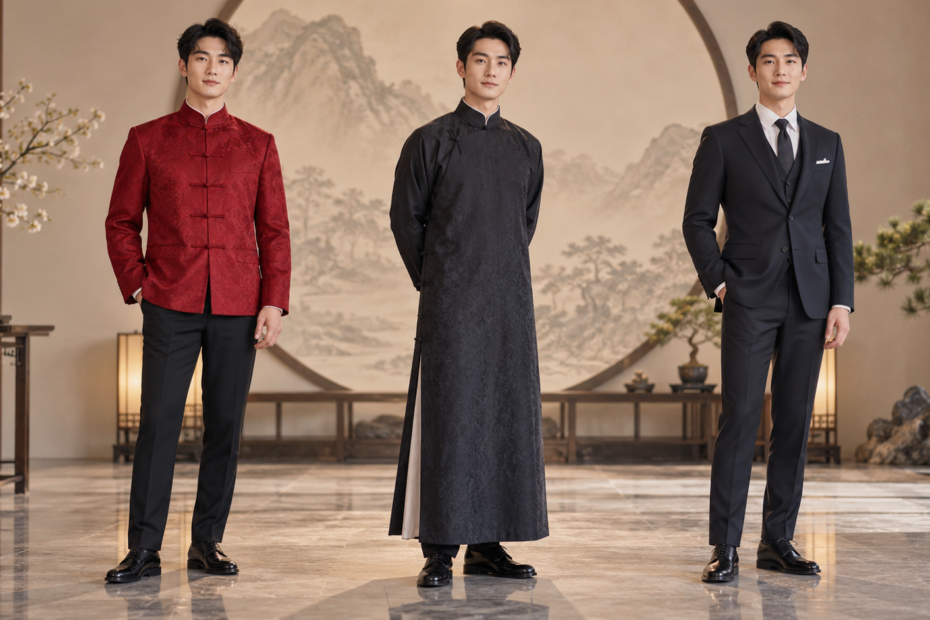
A Tang suit, changshan and Western suit give a groom three distinct silhouettes. A Tang suit is a hip-length Chinese-style jacket with a standing collar and frog closures. A changshan is a long men’s robe, typically reaching toward the ankles. A Western suit uses a lapelled jacket and matching tailored trousers. The best choice depends on family expectations, ceremony format, movement and the groom’s preferred level of cultural visibility.
How does each silhouette look?
The Tang suit creates a clear Chinese-style focal point around the collar and center front while leaving the trouser line visible. It can feel ceremonial without requiring a full-length robe.
The changshan creates the longest, most continuous line. Museum collections describe changshan as men’s long robes, and surviving examples show how length changes the wearer’s movement and visual presence. A Western suit produces the most familiar international formal silhouette with structured shoulders, lapels and coordinated trousers.
Which carries the clearest cultural signal?
A Tang suit communicates Chinese-style design immediately through the standing collar and knot closures. A changshan carries a distinct long-robe identity and may be selected when the family or ceremony has a specific connection to that garment.
A Western suit is culturally neutral in many contemporary wedding contexts because it is widely used for formal events. It can still be combined with Chinese wedding elements elsewhere in the celebration.
Which is easiest to move in?
A hip-length Tang suit generally allows familiar walking and sitting when properly fitted. The upper back, elbows and abdomen still need adequate ease.
A changshan requires attention to robe length, side openings and stride. The groom should rehearse stairs, sitting and any ceremony movements. A Western suit is familiar to many wearers, but a narrow jacket or trousers can also restrict reaching, kneeling or dancing.
Which works best for photographs?
The Tang suit keeps decorative details near the face and torso, making the collar and closures visible in seated and half-length portraits. A changshan is most effective in full-length images where the robe’s vertical line can be seen.
A Western suit gives photographers a predictable formal shape and coordinates easily with common venue styles. The result depends on fit more than category: poor sleeve length, pulling closures or an incorrect trouser hem will show in any option.
How should color be selected?
Red Tang suits are popular in celebratory settings, while navy, black and burgundy create quieter options. Changshan may be plain or patterned, depending on the specific design and family preference. Western suits are commonly chosen in black, navy or charcoal.
Ask whether the couple has reserved a color or motif. Compare the groom’s clothing with the partner’s outfit, décor and venue lighting before ordering.
Can the groom wear more than one?
Yes. A multi-outfit schedule can match clothing to different parts of the day. A groom might wear a Western suit for one ceremony and a Tang suit or changshan for a tea ceremony, banquet entrance or portraits.
Build realistic time into the schedule. Store each outfit with its trousers, shoes and accessories, and appoint someone to help protect long hems and fasteners.
What should be checked before buying?
For a Tang suit, check collar comfort, closure alignment and jacket measurements. For a changshan, add total length, side-opening placement and walking clearance. For a Western suit, examine shoulder fit, jacket length, sleeve exposure and trouser break.
Every option should be tested while sitting, reaching, walking and using stairs. Arrange alterations early, especially when decoration or robe construction limits where seams can be changed.
Decision guide for grooms
- Choose a Tang suit for a visible Chinese-style jacket that pairs easily with trousers.
- Choose a changshan for a distinctive long-robe silhouette and a relevant family or ceremony context.
- Choose a Western suit for widely recognized formal tailoring and easy coordination.
- Use an outfit change when different wedding moments call for different levels of tradition or formality.
Compare a statement dragon embroidery Tang suit with the lighter bamboo leaf casual Tang suit shirt. Check current options in the Panda-Tang shop and the Panda-Tang home page.
 English
 Français