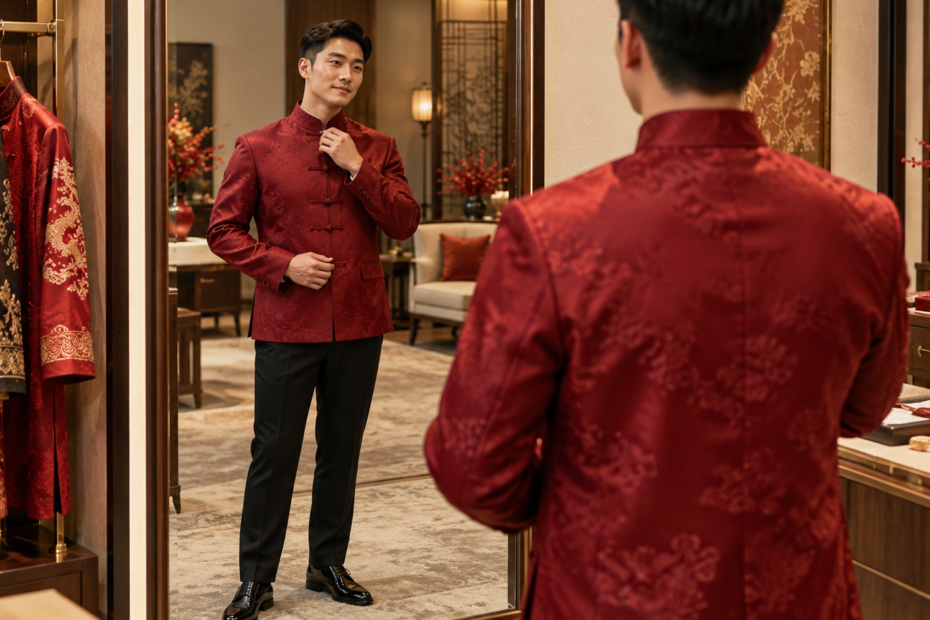
A groom buying a Tang suit for a wedding should begin with the event schedule, family expectations and accurate garment measurements. Color and embroidery matter, but a jacket that remains comfortable while sitting, greeting guests and taking photographs will serve the day better than one chosen only for appearance.
Use this checklist before ordering, again during the first fitting and once more with the complete wedding outfit.
1. Confirm when the Tang suit will be worn
Decide whether the jacket is for the main ceremony, a tea ceremony, a banquet entrance, portraits or the entire celebration. A garment worn for an hour can prioritize visual impact. An all-day outfit needs greater attention to breathability, movement and sitting comfort.
Wedding customs vary by family and region. Ask whether the couple or family has expectations about color, motifs or formality rather than relying on a universal rule.
2. Coordinate with the wedding color plan
Red is widely associated with celebratory occasions in many Chinese cultural settings, making it a common wedding choice. Deep red can feel restrained, while bright scarlet creates stronger visibility. Dark blue, black and other colors may also work when they match the couple’s plan.
Compare the jacket with the partner’s outfit, venue lighting and portrait background. A phone screen is not a reliable color standard, so request daylight photos or a fabric sample when an exact match matters.
3. Choose decoration for the groom’s role
Embroidery and contrast piping make the groom easy to identify in group photographs. Tonal frog closures and subtle woven patterns create a quieter formal result. The best level of decoration is the one that supports the event without competing with the partner’s clothing.
Inspect construction separately from symbolism. Embroidery should lie smoothly, closure attachment points should feel secure and the front should stay balanced when fastened.
4. Record body and garment measurements
Measure the chest, shoulder width, sleeve length and preferred jacket length. Then compare those numbers with the finished garment measurements, not only the S, M or L label. Different sellers can use very different size systems.
Allow enough ease for breathing and movement. The front should remain straight with every closure fastened, and the fabric should not spread open between knots.
5. Check the collar carefully
The standing collar frames the face in almost every wedding photograph. It should sit evenly and close without pressing the throat. Ask for the collar height and finished circumference if the listing does not provide them.
Wear the jacket for several minutes during the fitting. Turn the head, sit and look down. A collar that feels acceptable for a brief mirror check may become distracting over a long event.
6. Test wedding-day movement
Reach forward, lift a cup, hug someone, sit and stand while the jacket is fastened. These movements approximate common wedding moments and reveal tightness through the upper back, elbows and abdomen.
If the front rises or the closures pull sideways, a different size or cut may be better. Do not depend on a last-minute alteration to solve major proportion problems.
7. Select trousers and shoes together
Black or charcoal tailored trousers give a red or embroidered Tang suit a clean foundation. Straight or gently tapered legs usually balance a hip-length jacket. The waistband should remain smooth beneath the jacket when seated.
Choose shoes before setting the trouser hem. Plain dark leather shoes support a formal wedding, while restrained slip-ons may work for a less formal event. Walk on a surface similar to the venue.
8. Verify fabric and care information
Fabric affects sheen, structure, heat and crease behavior. Do not infer fiber content from a photograph or from the word “brocade.” Confirm the stated material and care method for the exact garment.
If the jacket will travel, test how it responds to folding and ask how it should be steamed or pressed. Keep direct heat away from decorative closures and embroidery unless the care instructions permit it.
9. Schedule alterations early
Arrange the first full fitting well before the wedding. Moving frog closures, piping or embroidery can be more complex than altering a plain seam. Leave time for a second fitting after any adjustment.
At the final fitting, wear the intended inner layer, trousers and shoes. Photograph the outfit from the front, side and back in natural light.
Final wedding purchase check
- The family and couple agree on color and level of formality.
- Finished garment measurements allow sitting and reaching.
- The collar is comfortable and even.
- Closures, seams and decoration are secure.
- Trousers and shoes are confirmed with the jacket.
- Care, travel and alteration plans are settled before the event.
Compare the statement look of the dragon embroidery Tang suit with the quieter bamboo leaf casual Tang suit shirt. Check current measurements and availability in the Panda-Tang shop, or begin at the Panda-Tang home page.
 English
 Français