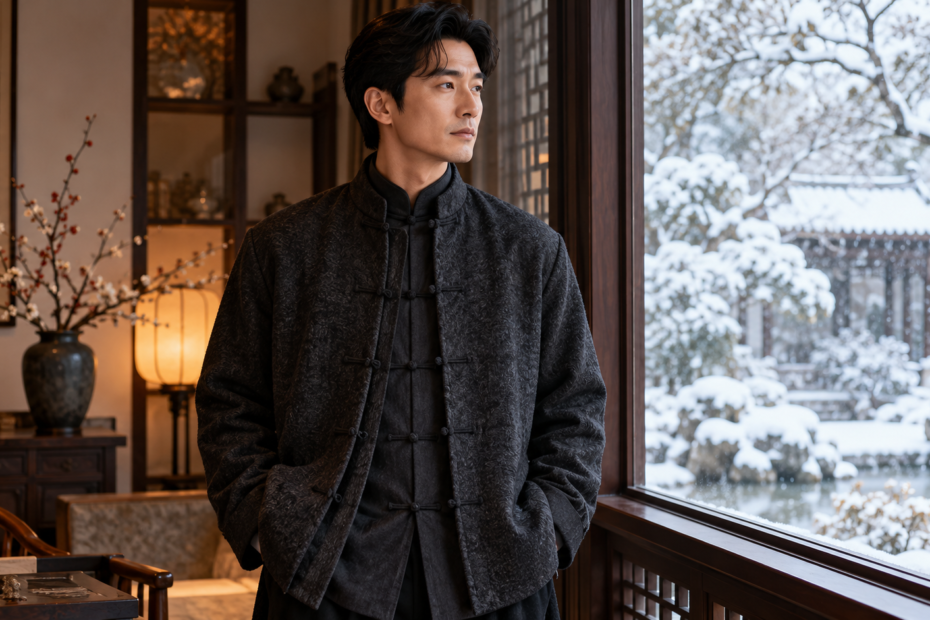
A winter Tang suit should accommodate planned layers without distorting the collar, shoulders, or frog closures. Warmth comes from the complete outfit—base layer, jacket, trousers, outerwear, and venue—not from a dark color or thick-looking photograph. Verify construction before ordering.
Plan the temperature transitions
Write down travel, outdoor waiting, photography, ceremony, dining, and dancing. A jacket comfortable outside can become too warm in a heated hall. The most flexible plan uses removable outerwear and a sensible base layer rather than forcing one garment to solve every temperature.
Measure over the real layers
Take chest, waist, shoulder, sleeve, and jacket-length measurements over the shirt or knit layer that will be worn. Compare them with finished-garment measurements and allow movement ease. Do not simply size up: extra width may drop the shoulders while sleeves and length remain poorly proportioned.
Evaluate fabric and lining
Ask for fiber composition, fabric weight, lining material, and care. Dense brocade and padded construction can add warmth, but may restrict drape. A smooth lining helps the jacket move over layers; a clingy lining can bunch at sleeves and back.
Protect collar and closure alignment
A bulky undershirt can crowd the standing collar. Fasten every frog closure while seated and check for horizontal strain. The front edge should remain straight. If a scarf is planned, test it with the collar rather than assuming both will sit comfortably.
Coordinate outerwear
The coat must fit over the Tang jacket without crushing its collar or pulling the sleeves. A simple longer overcoat often protects the outfit while keeping the visual focus on the jacket indoors. Check coat sleeve width, shoulder room, and hem relationship during a full fitting.
Choose decoration for winter light
Rich burgundy, navy, charcoal, and black can work well in winter, while metallic thread and glossy fabric react strongly to flash and warm indoor lighting. One focal motif is usually enough. Compare a statement dragon-embroidery Tang suit with a restrained bamboo-leaf Tang shirt.
Do not ignore trousers and shoes
Confirm trouser waist, hip, rise, thigh, and inseam over any thermal layer. Shoes need grip appropriate to conditions and should be cleaned before entering the venue. Test trouser break with the final footwear.
Manage care and weather exposure
Rain, snow, road salt, and indoor heat can affect delicate surfaces. Check cleaning instructions and avoid applying unverified water-repellent products. Use a garment bag for transport, hang the jacket promptly, and treat stains only according to the care label.
Winter wear test
- Dress in every intended layer.
- Fasten the jacket and outer coat.
- Sit, walk, reach, and use stairs.
- Remove the coat and check whether the jacket has bunched.
- Spend time in a heated room.
- Photograph the complete indoor and outdoor outfits.
Buy when the jacket fits the layered body, remains comfortable indoors, and works under practical outerwear. Browse the current Panda-Tang collection, then visit Panda-Tang to confirm materials, lining, measurements, care, returns, availability, and delivery.
 English
 Français